Hyrox Farmers Carry: Weight, Technique, Workouts & Benefits
Master the Hyrox farmers carry with division weights, grip technique, muscles worked, and periodized workouts to boost your race-day performance and overall finish time.
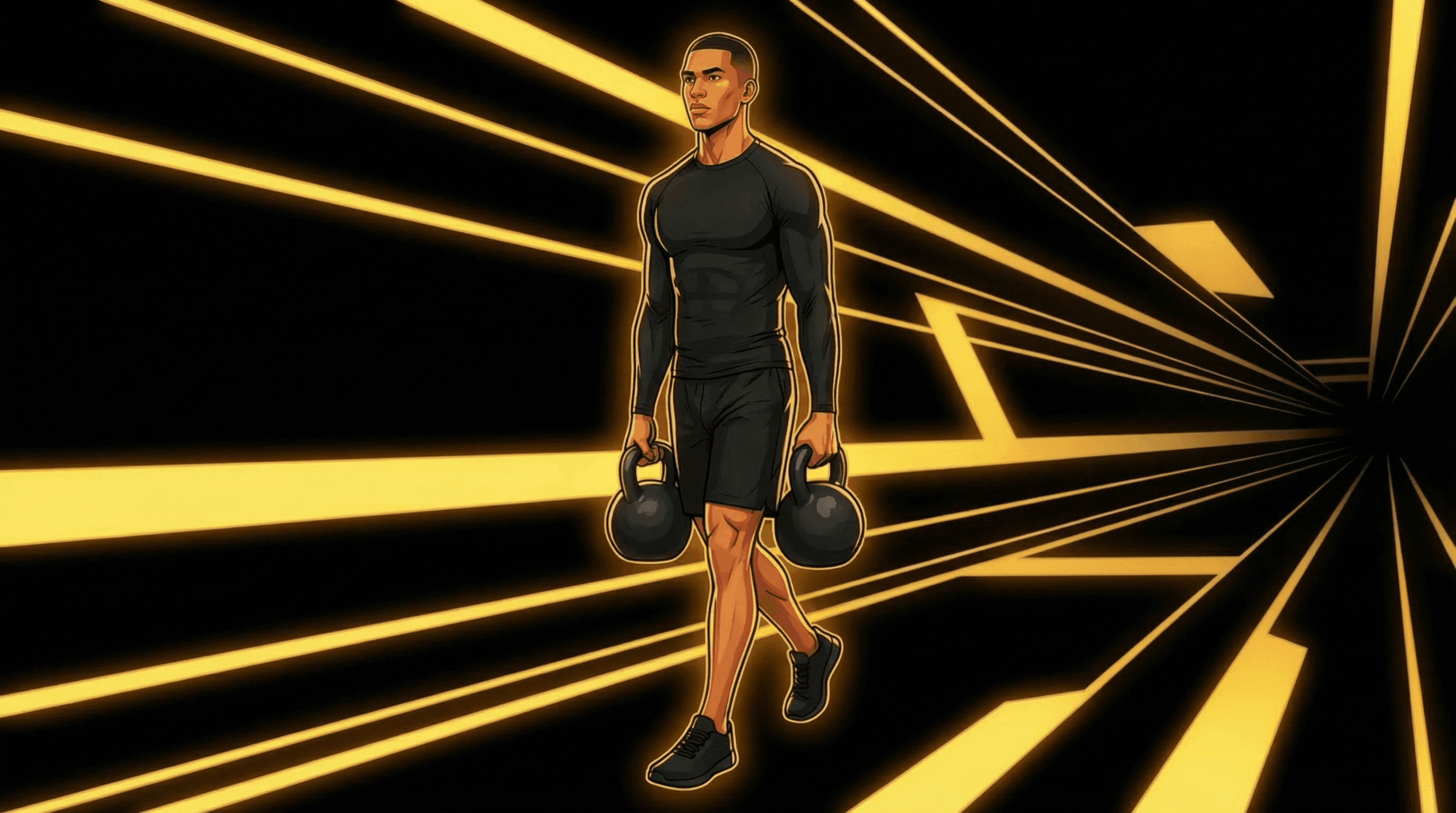
The farmers carry is the most honest exercise in all of fitness. Pick up something heavy. Walk. Don't put it down. That simplicity is what makes it so effective, and so revealing, on race day.
In HYROX®, the farmers carry covers 200 meters and lands as Station 6 of 8. By then you've run 6 kilometers, pushed and pulled sleds, rowed, and ground through burpee broad jumps. Your grip is cooked. Your posture is caving. And now you need to carry 24kg kettlebells (or heavier, depending on division) without stopping.
Across 800,000+ race entries in the ROXBASE database, the farmers carry shows the smallest time variance of any station. That might sound like good news. It isn't. It means there's almost no room to recover lost time here, but plenty of room to lose more if your grip gives out or your pacing collapses. The athletes who move smoothly through Station 6 aren't the strongest. They're the best prepared.
This page covers everything: HYROX® weights by division, the muscles worked, technique cues that save seconds, training workouts with dumbbells and kettlebells, weight-by-age benchmarks, carry variations, and the equipment that actually matters. If you're racing HYROX® or training for one, this is your complete farmers carry resource.
What Is the Farmers Carry?
The farmers carry is a loaded carry exercise where you hold a heavy weight in each hand and walk for a set distance or time. That's it. No complicated movement pattern, no learning curve measured in weeks. You grip, you brace, you walk.
The name comes from the obvious place: farmers have been carrying heavy things across fields for centuries. The exercise entered formal strength training through strongman competitions, where athletes carry massive implements over 50-100 meter courses. From there, it spread into general fitness, physical therapy, and sport-specific training for one reason: it works.
What makes the farmers carry exercise unique is that it loads your entire body under movement. Unlike a deadlift (static hold at the top) or a squat (vertical loading), the carry forces your grip, core, shoulders, hips, and legs to stabilize while you walk. Every step is a single-leg balance challenge with external load. Your body has to resist rotation, lateral sway, and spinal compression simultaneously.
You can perform the movement with dumbbells, kettlebells, trap bars, specialty farmers carry handles, or even heavy grocery bags. The implement changes the grip demand and loading potential, but the core movement stays identical.
For HYROX® athletes, the farmers carry sits at Station 6: a 200-meter walk with kettlebells after 6km of running and five completed stations. Your cardiovascular system is taxed. Your forearms are fatigued from sled pulls and rowing. And now you need to maintain a brisk walking pace under load without setting the weights down. It's a test of preparation, not talent.
If you want a deeper breakdown of why this exercise delivers more than it promises, our guide on 7 key farmers carry benefits goes into the research and practical applications.
Farmers Carry in HYROX®: Distance, Weight & Rules
Station 6 in HYROX® requires you to carry two kettlebells for 200 meters. The course is typically an out-and-back layout inside the venue, with a turnaround at the 100-meter mark. You pick up the kettlebells from a designated area, walk the course, and set them down at the end. If you drop them mid-carry, you can pick them back up with no formal penalty, but every drop costs 3-5 seconds minimum between setting down, resetting your grip, and rebuilding your brace.
The 200-meter distance makes this a 90-to-150-second effort for most competitors. Pro athletes complete it in under 90 seconds. Open division racers typically fall in the 100-130 second range. And if your grip fails, that number can balloon past 3 minutes with multiple rest stops.
Rules are straightforward: carry both kettlebells for the full distance. No dragging. No resting the kettlebells on your forearms or shoulders (it's not a rack carry). Both feet must cross the finish line with both kettlebells in hand. For a full breakdown of HYROX® farmers carry weights across all divisions, we've built a dedicated reference.
Weight by Division & Gender
The HYROX® farmers carry weight varies by division and gender. Here's what you'll carry on race day:
| Division | Men (per hand) | Women (per hand) | Total Load |
|---|---|---|---|
| Open | 24kg | 16kg | 48kg / 32kg |
| Pro | 32kg | 24kg | 64kg / 48kg |
| Doubles Open | 24kg | 16kg | 48kg / 32kg |
| Doubles Pro | 32kg | 24kg | 64kg / 48kg |
For Pro men, carrying 64kg total over 200 meters after 6km of running is a serious grip and structural demand. For Open women at 32kg total, the weight is lighter but the fatigue context is identical. Both need specific preparation.
A common mistake: training with the exact race weight and calling it done. Race-day fatigue means your 24kg carry in a fresh state feels like 30-32kg at Station 6. Train 10-15% heavier than race weight in training to build that buffer.
200m Pacing & Grip Strategy
The biggest pacing error on the farmers carry is starting too fast. You pick up the kettlebells feeling strong (relative to the sled push and pull you just survived), take off at a near-jog pace, and your grip gives out at 120 meters. Now you're standing in the middle of the course, shaking out your forearms, watching other athletes walk past.
A better approach: start at 85% of your maximum walking speed and hold it. Aim for a consistent pace of roughly 1:20-1:40 per 100 meters in Open division. That translates to finishing in 2:40-3:20 total, which is competitive without being reckless.
Coach's Note: Your grip has two enemies at Station 6: accumulated fatigue from sled pulls and rowing, and sweat. Chalk your hands before picking up the kettlebells if the venue allows it. If not, wipe your palms on your shorts. Two seconds of drying can save a 5-second mid-carry drop.
Grip strategy matters as much as pace. Use a full-fist crush grip, not a fingertip hold. Keep your shoulders packed down and back, which shortens the lever arm and reduces the load on your forearms. Breathe in a rhythm: inhale for 3-4 steps, exhale for 3-4 steps. Holding your breath spikes blood pressure and accelerates grip fatigue.
For a deeper dive into grip-specific preparation, read our farmers carry grip training guide, which covers forearm endurance protocols and race-day tricks.
Muscles Worked
The farmers carry works more muscles simultaneously than almost any other single exercise. A 2019 analysis of loaded carries found that the movement activates over 20 distinct muscle groups during a single effort. That's because your body has to solve multiple problems at once: grip the weight, stabilize the spine, control lateral sway, and propel yourself forward.
This full-body activation is why the farmers carry exercise appears in programs for athletes across every sport, not only HYROX®. It builds functional strength in patterns that transfer directly to performance and daily life. For a complete anatomical breakdown, our farmers carry muscles worked guide maps every muscle group involved.
Primary & Secondary Muscles
Primary movers and stabilizers (high activation throughout the carry):
- Forearm flexors (grip): Your flexor digitorum profundus and superficialis work at near-maximal sustained contraction. This is the muscle group that fails first in 90% of athletes.
- Trapezius (upper and middle): Holds the shoulder girdle in position against the downward pull of the load. Responsible for that "shoulders packed" cue.
- Erector spinae: Runs the length of your spine, resisting flexion (rounding) under load. Works harder than during most deadlift variations because of the walking component.
- Obliques and transverse abdominis: Anti-rotation and anti-lateral-flexion. Every single step tries to tip you sideways; your obliques prevent it.
- Gluteus medius: Stabilizes the pelvis during single-leg stance phases. Without it, your hips drop with each step, wasting energy.
Secondary muscles (moderate activation):
- Quadriceps and hamstrings: Propulsion and knee stability during walking under load.
- Gastrocnemius and soleus (calves): Push-off force and ankle stability.
- Rhomboids: Scapular retraction, working with the traps to keep your upper back from rounding.
- Deltoids (all three heads): Stabilize the shoulder joint under the downward pull of the load.
- Rectus abdominis: Anti-extension, preventing excessive lumbar arch under heavy loads.
FULL-BODY ACTIVATION
The farmers carry engages 20+ muscle groups simultaneously. For comparison, a barbell back squat primarily activates 7-9 muscle groups. This makes the carry one of the most efficient exercises per minute of training time.
What does this mean for your HYROX® training? The farmers carry trains almost every muscle you use during the other seven stations. Stronger grip transfers to sled pulls and rowing. A more stable core improves running economy. Better hip stabilization carries over to sandbag lunges and burpee broad jumps. It's the single exercise with the widest transfer to the rest of the race.
Benefits
The farmers carry delivers an unusually high return on training time. A 10-minute farmers carry session, including rest periods, trains grip endurance, core stability, hip control, upper back strength, and cardiovascular conditioning. No other single exercise checks that many boxes that fast.
For HYROX® athletes, the benefits compound. Every improvement to your carry transfers to at least 2-3 other stations. Stronger grip means faster sled pulls. Better core stability means more efficient running. Improved posture endurance means you hold form through sandbag lunges when fatigue sets in at Station 7.
Across our database of 700,000+ athletes, the farmers carry shows the most consistent station times. That consistency cuts both ways. Weak athletes don't lose as much time here compared to other stations, but strong athletes can't gain as much either. The benefit of carry training isn't a massive time drop at Station 6. It's the compound effect across your entire race. Read our full breakdown of 7 reasons farmers carries belong in your program for the complete picture.
Grip, Core & Posture
Grip endurance: Most adults can hold a maximal grip contraction for 30-45 seconds before failure. A HYROX® farmers carry lasts 90-150 seconds. That means you need to carry at a sub-maximal grip intensity and sustain it. Training carries at 70-80% of your max grip capacity for 60-90 second sets builds the endurance base that prevents mid-carry drops. For athletes who struggle here, our grip training protocol offers a 4-week progression.
Core stability under movement: Planks train static core stability. Farmers carries train dynamic core stability, which means maintaining spinal position while your body moves through space under load. Each step creates rotational and lateral forces your core must counteract. Training this pattern 2-3 times per week for 4 weeks can improve your running posture noticeably, because the same stabilization muscles fire during every stride.[1]
Posture endurance: By Station 6, most HYROX® athletes have lost 10-15% of their upright posture. Shoulders round forward. The thoracic spine flexes. Hip drive diminishes. The farmers carry, performed with proper technique in training, builds the structural endurance to resist this collapse. Athletes who train heavy carries report better posture through Stations 7 and 8, which is where races are often decided.
GRIP BENEFIT
- Sustain sub-maximal hold for 90-150 seconds
- Transfers to sled pull, rowing, and wall balls
- Reduces risk of mid-carry drops on race day
CORE BENEFIT
- Dynamic anti-rotation and anti-lateral-flexion
- Transfers directly to running economy
- More effective than static planks for carry athletes
POSTURE BENEFIT
- Builds structural endurance through upper back
- Prevents late-race posture collapse
- Improves performance at Stations 7 and 8
Technique & Form
Good farmers carry technique isn't complicated. But the difference between decent form and dialed-in form is 10-20 seconds over 200 meters, which in a race with minimal station variance, matters.
Here's the step-by-step breakdown:
1. The pickup. Stand between the two weights with feet hip-width apart. Hinge at the hips (not the lower back) and grip both handles with a full-fist crush grip. Drive through your legs to stand tall. Think "deadlift," not "curl." This initial lift sets your posture for the entire carry. If you start rounded, you stay rounded.
2. The set position. Once standing, pull your shoulders down and back. Think about putting your shoulder blades in your back pockets. Brace your core as if someone is about to punch you in the stomach. Eyes forward, chin neutral. Not looking down at your feet. Not looking up at the ceiling.
3. The walk. Take short, quick steps. Not long strides. Long strides increase lateral sway and force your core to work harder with each step. Aim for a step cadence roughly 10-15% faster than your normal walking pace. Keep the weights slightly away from your thighs (2-3 inches) to prevent them from banging into your legs, which disrupts rhythm and can cause bruising over 200 meters.
4. Breathing. Breathe in a rhythmic pattern: inhale for 3-4 steps, exhale for 3-4 steps. Never hold your breath for more than a few seconds. Holding your breath (Valsalva maneuver) spikes intra-abdominal pressure, which aids short maximal efforts but accelerates fatigue over a 90+ second carry.
5. The turn. In HYROX®, the 200m course usually has a turnaround. Slow down slightly before the turn. Take small, controlled steps through the turn rather than a wide arc. A tight, controlled turn saves 1-2 seconds compared to a wide swing.
Coach's Note: The most common form breakdown happens between 120-160 meters. Shoulders creep up toward the ears, breath becomes shallow, and step length increases as athletes try to "get it over with." When you feel this happening, actively reset: pull shoulders down, exhale fully, shorten your steps. A 2-second mental reset at 150 meters prevents a 5-second grip failure at 180 meters.
For race-specific technique adjustments and tips from athletes who've completed 3+ HYROX® events, check our HYROX® farmers carry race tips guide.
Workouts for HYROX®
Training the farmers carry for HYROX® requires more than picking up heavy weights and walking around the gym. You need to build three specific capacities: grip endurance beyond 90 seconds, structural stability under fatigue, and the ability to transition from a carry back into running without your pace collapsing.
The best farmers carry workouts for HYROX® simulate race conditions. That means training carries after running intervals. It means working at or above race weight. And it means programming carries alongside other station work in the same session.
Here are three workout structures, progressing from foundational to race-specific:
Workout 1: Grip Endurance Builder (Weeks 1-4)
- 4 x 100m farmers carry at race weight
- 60 seconds rest between sets
- Focus: zero drops, consistent pace, rhythmic breathing
- Progress by reducing rest to 45 seconds, then 30 seconds
Workout 2: Fatigue Simulation (Weeks 5-8)
- 500m run at threshold pace
- Immediately into 200m farmers carry at race weight
- 500m run at threshold pace
- Repeat 3 times. Rest 2 minutes between rounds.
Workout 3: Race Rehearsal (Weeks 9-12)
- 1km run at race pace
- 200m farmers carry at race weight + 10%
- 1km run at race pace
- 100m sandbag lunges
- Goal: maintain run splits within 5 seconds of each other despite carry fatigue
Dumbbell Farmers Carry
Dumbbells are the most accessible tool for farmers carry training. Most gyms stock them up to 50kg per hand, which covers every HYROX® division's requirements with room for overload.
The dumbbell farmers carry has a slightly different grip angle compared to kettlebells. The load sits in line with your hand rather than below it, which reduces rotational grip demand but increases crush grip demand. Both are useful. Training with dumbbells builds the raw grip strength that supports kettlebell performance on race day.
For dumbbell-specific programming and progressions, we've built a complete guide. Key recommendation: start at 28-32kg per hand for Open men, 20-24kg per hand for Open women, and progress by 2kg every 2-3 weeks while maintaining 200m unbroken.
Kettlebell Farmers Carry
Since HYROX® uses kettlebells, training with kettlebells is the most specific preparation you can do. The kettlebell handle is thicker than a dumbbell, which increases grip demand. The load hangs below the handle, creating a pendulum effect with each step that your forearms must control.
Training with kettlebell farmers carries at least once per week in the 8 weeks before your race is a non-negotiable. Get your hands accustomed to the specific grip width, the swing pattern, and the wrist position. A 24kg kettlebell dumbbell carry feels different from a 24kg kettlebell carry, even though the weight is identical.
Coach's Note: If your gym doesn't have the exact race-weight kettlebells, go heavier rather than lighter. Carrying 28kg kettlebells in training makes 24kg feel manageable on race day. ROXBASE automatically adjusts carry weights based on your available equipment and selects the best substitute exercise if kettlebells aren't available.
Weight by Age - Calculator & Charts
One of the most common questions in carry training: "How much should I be able to carry for my age and gender?" The answer depends on training age, bodyweight, and goals, but population-level benchmarks help you gauge where you stand.
Our farmers carry by age calculator uses data from strength standards across age groups to give you a personalized target. The charts below show general benchmarks for a 200m carry (the HYROX® distance) based on age, assuming the goal is to complete the distance unbroken.
Male Standards
| Age Range | Beginner (per hand) | Intermediate (per hand) | Advanced (per hand) | HYROX® Open |
|---|---|---|---|---|
| 18-24 | 16kg | 28kg | 40kg | 24kg |
| 25-34 | 20kg | 32kg | 44kg | 24kg |
| 35-44 | 18kg | 28kg | 40kg | 24kg |
| 45-54 | 16kg | 24kg | 36kg | 24kg |
| 55+ | 12kg | 20kg | 32kg | 24kg |
Notice that the HYROX® Open weight (24kg per hand) falls solidly in the intermediate range for men aged 25-44. That aligns with the core HYROX® demographic: ~76% of 700,000+ athletes in our database fall in the 25-44 age bracket. For most men in this range, the carry weight itself isn't the problem. The problem is carrying it after 45+ minutes of racing.
Female Standards
| Age Range | Beginner (per hand) | Intermediate (per hand) | Advanced (per hand) | HYROX® Open |
|---|---|---|---|---|
| 18-24 | 10kg | 18kg | 28kg | 16kg |
| 25-34 | 12kg | 20kg | 32kg | 16kg |
| 35-44 | 10kg | 18kg | 28kg | 16kg |
| 45-54 | 8kg | 16kg | 24kg | 16kg |
| 55+ | 6kg | 12kg | 20kg | 16kg |
For women aged 45-54, the HYROX® Open weight (16kg per hand) sits right at the intermediate threshold. This means grip-specific training becomes even more important for athletes in this bracket. If you're at or near the boundary, 6-8 weeks of dedicated carry training can shift you from "barely completing" to "comfortably finishing" the 200 meters.
These charts represent general population benchmarks. Your individual numbers depend on bodyweight, training history, and grip-specific conditioning. The full age calculator accounts for more variables to give you a tighter estimate.
Variations
The standard bilateral farmers carry is your bread and butter. But variations serve specific purposes: addressing asymmetries, increasing core demand, training around equipment limitations, or adding variety to a 12-week training block.
Here are the variations that matter most for HYROX® athletes, ranked by how directly they transfer to race-day performance.
Suitcase Carry vs Farmers Carry
The suitcase carry is a single-arm farmers carry: one weight in one hand, nothing in the other. It's called a suitcase carry because it looks like you're carrying luggage through an airport.
The key difference is anti-lateral-flexion demand. With load on only one side, your obliques on the opposite side must fire significantly harder to keep you upright. Research on unilateral loading shows 30-40% greater oblique activation compared to bilateral carries at the same per-hand weight.
| Factor | Farmers Carry (bilateral) | Suitcase Carry (unilateral) |
|---|---|---|
| Core demand | Anti-rotation + anti-extension | Anti-lateral-flexion (much higher) |
| Grip demand | Split between both hands | Concentrated in one hand |
| Total load possible | Higher (balanced) | Lower (limited by lateral stability) |
| HYROX® specificity | Direct (race movement) | Indirect (accessory) |
| Best use | Race preparation, strength building | Core stability, asymmetry correction |
For a complete programming comparison, our suitcase carry vs farmers carry breakdown covers when to use each and how to program both in a HYROX® training block. A good rule: use the suitcase carry once per week as an accessory. Use the bilateral farmers carry 1-2 times per week as your primary carry work.
The one-arm farmers carry guide goes deeper into unilateral carry progressions and their role in injury prevention.
Treadmill Farmers Carry
Yes, you can do a farmers carry on a treadmill, and for some training contexts, it's a strong option. Set the treadmill to walking speed (4.5-5.5 km/h), pick up your weights, and walk. The belt controls your pace, which removes the temptation to slow down when your grip starts to fatigue.
The treadmill version works well for pace discipline training. Set it to your target race pace (roughly 7-9 km/h for competitive athletes) and hold on for 200m. You'll know within 30 seconds if your pace target is realistic under load.
Caution: treadmill farmers carries require confidence with the movement. If your grip fails and you drop a weight, it can land on the belt and fly backward. Start with lighter weights (60-70% of race weight) until you're comfortable with the treadmill-specific balance demands. Our complete treadmill farmers carry guide covers safety setup, speed progression, and when to switch to floor carries.
Other variations worth programming:
- Trap bar farmers carry: Allows heavier loading than kettlebells or dumbbells. Great for maximal strength building in the off-season. See our trap bar carry guide for loading recommendations.
- Overhead carry: Builds shoulder stability and thoracic extension. Use as a warm-up at 30-40% of your farmers carry weight.
- Mixed carry (one hand overhead, one hand at side): Trains anti-rotation with an asymmetric load. Advanced variation for athletes with at least 6 months of carry training.
Equipment & Handles
Your equipment choice affects grip width, load position, and maximum weight. Here's what matters for each option:
KETTLEBELLS (Race Standard)
- HYROX® competition implement
- Thicker handle increases grip demand
- Load hangs below hand (pendulum effect)
- Standard competition sizes: 16kg, 24kg, 32kg
- Best for: race-specific training (final 8 weeks)
DUMBBELLS (Most Accessible)
- Available in most gyms up to 50kg+
- Load in line with hand (less rotational demand)
- Knurled handle improves grip in sweaty conditions
- Smaller weight jumps (2kg increments)
- Best for: progressive overload, general prep
FARMERS CARRY HANDLES
- Purpose-built for heavy carries
- Loadable with weight plates (no upper limit)
- Neutral grip, similar to competition kettlebells
- Takes up floor space, not available at most gyms
- Best for: heavy strength work, strongman crossover
TRAP BAR
- Centered load, most natural carry position
- Highest loading potential of any option
- Doesn't replicate bilateral grip of race implements
- Available at most serious gyms
- Best for: off-season max strength, overload phases
For home gym athletes, dedicated farmers carry handles are a worthwhile investment if you're training for multiple HYROX® seasons. Loadable to 100kg+ per hand, they last forever and allow precise weight progression. Our farmers carry handles buying guide reviews the top options across price points.
If you're training with limited equipment, ROXBASE contains 216 exercises with prioritized alternatives for every movement. The app automatically substitutes the best alternative based on your available equipment, prioritizing free weights over machines (barbell → dumbbell → kettlebell → bodyweight → machine) across four equipment tiers.
Alternatives
Sometimes you can't perform a standard farmers carry. Maybe your gym doesn't have enough floor space. Maybe you're training in a hotel gym with limited weight. Maybe you have a wrist injury that prevents loaded grip work. Here are the best farmers carry alternatives, ranked by how closely they replicate the demands of the original movement.
| Alternative | Grip Transfer | Core Transfer | Carry-Specific | Best For |
|---|---|---|---|---|
| Suitcase carry | High | Very high | Yes | Core emphasis, asymmetry work |
| Sandbag carry (bear hug) | Low | High | Yes | Upper back endurance, no grip limit |
| Hex bar deadlift holds | High | Moderate | No (static) | Grip max strength, limited space |
| Plate pinch walks | Very high | Moderate | Yes | Finger/thumb grip strength |
| Dead hangs (weighted) | High | Low | No (static) | Grip endurance, minimal equipment |
| Barbell suitcase holds | High | Very high | No (static) | Anti-lateral-flexion, limited space |
No alternative fully replicates the farmers carry. The combination of bilateral grip, locomotion, full-body stabilization, and sustained duration is unique to the movement. Use alternatives to address specific weaknesses (grip strength, core stability) or work around limitations, but prioritize the actual carry whenever possible.
For a hotel-room workout: 3 sets of 60-second weighted dead hangs (use a sturdy door frame pull-up bar) + 3 sets of 30 suitcase carry steps per side with the heaviest dumbbell available. It won't replicate 200 meters at 24kg per hand. But it maintains the grip endurance and core stability you've built in proper training sessions.
FAQ: All Questions
Sources
Knapik JJ, Harman EA, Steelman RA (2012). A systematic review of the effects of physical training on load carriage performance. *Journal of Strength and Conditioning Research*. https://doi.org/10.1519/JSC.0b013e3182429853 ↩
Was this helpful?
More Training Guides
HYROX for Women: Training Plans, Weights & Race Guide
HYROX for women explained: women-specific weights, training plans, hormonal periodization, and race strategy using data from 325,000+ female athletes.
HYROX Race Day: Results, Checklist & Strategy Guide
Decode your HYROX results with age-group benchmarks, station-by-station split analysis, and a proven race day checklist to hit your personal best.
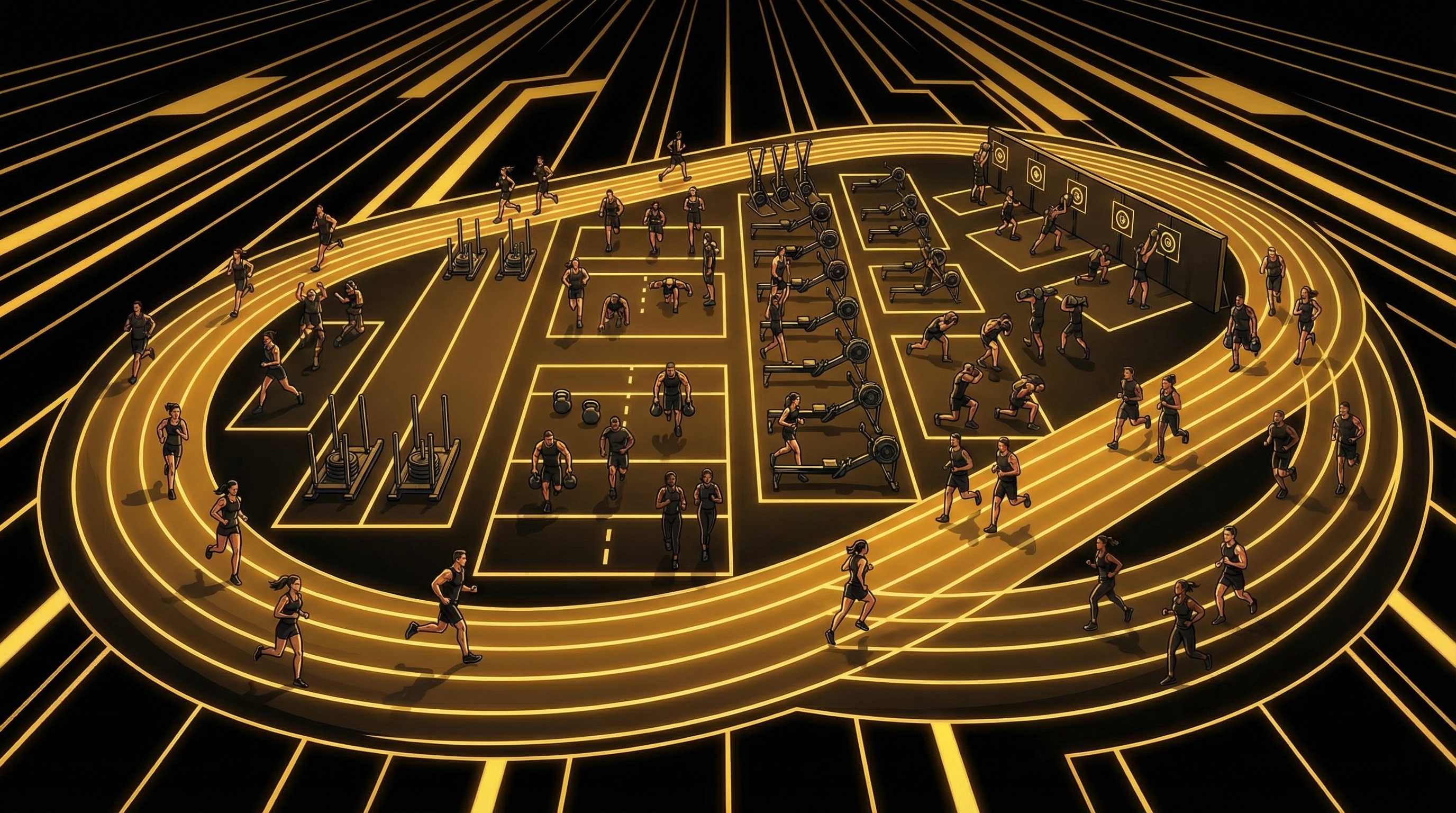
The Complete Hyrox Workout: All Exercises & Stations Explained
Master every Hyrox workout station, running split, and weight standard. Includes pacing strategy, periodization plans, and programming for all divisions.
Know Where You Stand
Reading is good. Knowing exactly where your minutes are hiding is better. Get your race breakdown and a plan that targets your weakest stations.
Analyze My Race