Hyrox Sled Push: Weights, Technique, Workouts & Alternatives
Master the Hyrox sled push with weight standards by division, proven technique for any surface, training workouts, and race-ready programming to boost your time.
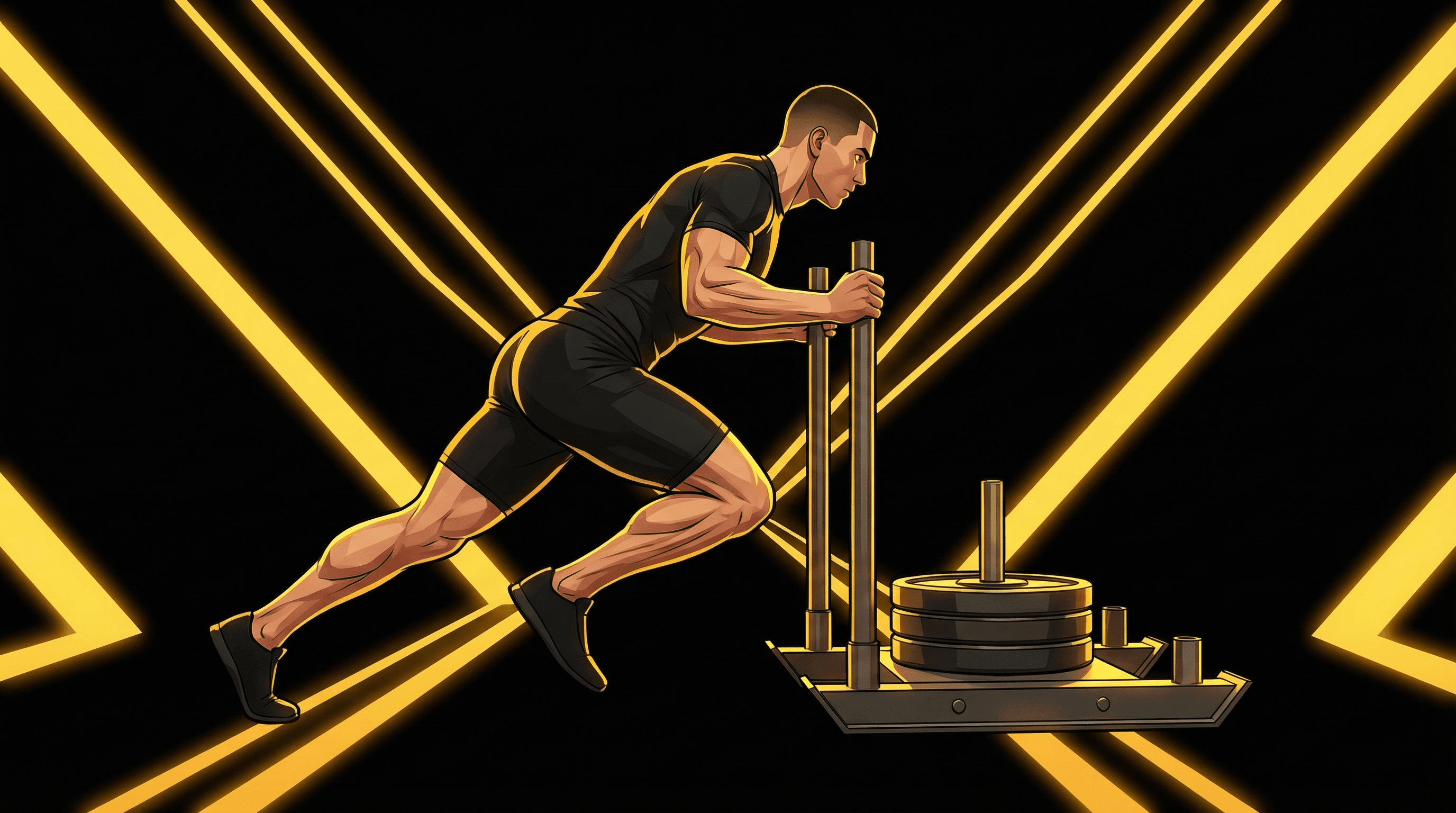
The sled push station at HYROX® breaks more race plans than any other. Fifty meters of grinding, leg-burning effort that separates athletes who trained smart from those who trained hopeful. Across 800,000+ race entries in the ROXBASE database, sled push times show one of the widest performance gaps between divisions, and the station sits early enough in the race (station 2 of 8) to wreck your pacing if you get it wrong.
This page covers everything you need to push faster: official weights for every division, the technique that keeps you moving when your quads scream, the muscles that drive the sled, workouts built for race day, and alternatives for athletes who don't have access to a sled. Every recommendation is grounded in data from 707,045 unique athlete profiles and real race-day performance patterns.
One number to anchor your training: the difference between a fast and slow sled push in the Open division is often 60-90 seconds. That gap alone can move you up hundreds of places in the results. The sled doesn't care about your ego. It only responds to preparation.
Sled Push in HYROX®: Distance, Weight & Rules
The HYROX® sled push is station 2 of 8. You'll hit it after your second 1km run, when your heart rate is already elevated but your legs still have most of their glycogen. The task: push a weighted sled 50 meters down a track. No handles to pull, no straps. Your hands grip the uprights and your legs do the rest.
The sled sits on a synthetic track surface that varies slightly between venues. Some floors feel stickier than others, which is why experienced racers warm up on the actual competition surface when possible. For a deeper breakdown of how distance and surface interact, check out our post on HYROX® sled push distance explained.
Rules are straightforward: push the sled the full 50 meters. You can stop and rest, but the clock keeps running. No pulling, no rope assists. Both hands must stay on the sled. The weight loaded on the sled depends on your division, gender, and whether you're racing singles or doubles.
Here's what makes the sled push deceptive: 50 meters sounds short. But at race weight, with elevated heart rate, those 50 meters can take anywhere from 30 seconds (elite Pro athletes) to well over 3 minutes (first-time Open racers who underestimated the load). For race-day tactics on managing this station, see our sled push HYROX® race tips.
Weight Standards by Division & Gender
How heavy is the sled push in HYROX®? The sled itself weighs roughly 30 kg unloaded. Additional plates are added based on your division and gender. Total sled weight (sled + plates) ranges from 102 kg for women's Open to 202 kg for men's Pro.
Here's the full breakdown:
| Division | Men (Total) | Women (Total) |
|---|---|---|
| Open Singles | 152 kg | 102 kg |
| Pro Singles | 202 kg | 152 kg |
| Doubles Open | 152 kg (shared) | 102 kg (shared) |
| Doubles Pro | 202 kg (shared) | 152 kg (shared) |
| Mixed Doubles Open | 127 kg (shared) | |
| Mixed Doubles Pro | 177 kg (shared) | |
These weights are standardized globally across all HYROX® events. For a detailed guide to every division's load, read HYROX® sled push weight: all divisions.
Pro vs Open vs Doubles Weights
The 50 kg jump from Open to Pro is significant. At men's Open (152 kg), most trained athletes can maintain a steady push for the full 50 meters with one or two brief pauses. At men's Pro (202 kg), even strong athletes need a deliberate pacing strategy.
That 50 kg difference translates to roughly 20-40 extra seconds on the sled for most athletes. In Pro fields, where finishing positions are separated by slim margins, sled push technique and leg strength become even more decisive.
Doubles teams push the same sled weight as their equivalent singles division, but with two athletes. This means each person accounts for roughly half the load. That's why many athletes start their HYROX® career in doubles (66% of all race participations are doubles, according to ROXBASE data) before stepping up to singles.
Coach's Note: If you're on the fence between Open and Pro, test yourself at the Pro sled weight during training. If you can push 202 kg (men) or 152 kg (women) for 50m in under 90 seconds fresh, you'll likely survive it on race day. If not, build your base in Open first.
Women's Sled Push Weight
Women's Open sled push weight is 102 kg total. Women's Pro is 152 kg, the same load as men's Open. This is one of the biggest jumps in the entire women's HYROX® experience, and it's why dedicated strength work matters more for women moving from Open to Pro than almost any other station change.
Across ROXBASE athlete data, women who improve their sled push time by 15+ seconds between their first and second race typically added structured lower-body strength training (squats, lunges, leg press) at least twice per week. The sled rewards raw leg drive. There's no shortcut.
For women training at 102 kg: focus on speed and continuous movement. At this weight, the goal should be zero stops over 50 meters. For women training at 152 kg (Pro): pace yourself. Two or three controlled pauses beat one max-effort burst that leaves you unable to run the next kilometer.
Technique & Form
Sled push technique accounts for more time variance than raw strength. ROXBASE race data shows that athletes with similar squat numbers can differ by 30+ seconds on the sled. The reason: body angle, foot placement, and drive mechanics matter more than brute force when the sled is on the ground and friction is the enemy.
Get the technique right and every watt of leg power goes into forward motion. Get it wrong and you waste energy pushing into the floor instead of down the track. For a complete technique walkthrough, see our detailed post on sled push technique for max power.
Body Position & Drive Phase
How to do sled pushes: Start with your hands on the vertical uprights, arms extended. Drop your hips until your torso forms a 30-45 degree angle with the ground. Your shoulders should be ahead of your hips. Think "falling forward" before you drive.
Here's the step-by-step:
- Grip the uprights at chest height or slightly lower. Straight arms, locked elbows. Your arms are a rigid frame, not a pushing mechanism.
- Drop your hips low. The lower your center of gravity, the more horizontal force you generate. If your hips are high, you're pushing the sled down into the track, not forward along it.
- Drive through the balls of your feet. Short, powerful steps. Think of a sprinter's start: aggressive knee drive, full extension through the ankle, quick turnover.
- Keep your head neutral. Look 2-3 meters ahead, not at the sled or the ceiling. This keeps your spine aligned and your body angle consistent.
- Breathe rhythmically. Exhale on every push step. Holding your breath spiking intra-abdominal pressure for 50 meters is a recipe for seeing stars.
The most common mistake: standing too upright. Every degree you rise from that 30-45 degree angle costs you forward force. On race day, fatigue makes you want to stand up. Fight it. The low position is everything.
Coach's Note: Film yourself from the side during sled push training. Watch for the moment your hips rise above 45 degrees. That's your technical breakdown point. Train specifically at that fatigue level to build the positional awareness that holds up on race day.
Low Push vs High Push
The sled push exercise offers two distinct grip positions: low handles (if available) and high handles. In HYROX®, you push on vertical uprights, which means you choose your effective height by where you grip and how low you drop your hips.
A low push (hands around hip height, torso nearly horizontal) maximizes horizontal force. It's the fastest approach for athletes with strong hamstrings and good hip mobility. The trade-off: it demands more from your lower back and makes breathing harder under load.
A high push (hands at chest height, torso at roughly 45 degrees) is more sustainable. You breathe easier, your lower back takes less strain, and you can maintain a consistent pace over the full 50 meters. For heavier loads (Pro division), most athletes are faster with the high push because they can sustain effort without rest breaks.
The sweet spot for most HYROX® athletes: start with a moderate-low position for the first 15-20 meters when you're freshest, then allow a slight rise to the high position for the remaining 30 meters. This hybrid approach balances speed with sustainability. If you're targeting a sub-60-second sled push, the low position throughout is the play, but only if your posterior chain can handle it.
Muscles Worked
What muscles does sled push work? The sled push is a full-body push-dominant movement, but 80%+ of the force comes from your lower body. Your quads, glutes, and calves are the primary drivers. Your core and upper body act as the rigid transmission that transfers leg power into the sled.
Here's the breakdown by muscle group and role:
| Muscle Group | Role | Contribution |
|---|---|---|
| Quadriceps | Knee extension on every drive step | Primary mover |
| Glutes | Hip extension, power generation | Primary mover |
| Calves (Gastrocnemius & Soleus) | Ankle plantar flexion, ground contact force | Primary mover |
| Hamstrings | Hip extension assist, knee stabilization | Secondary mover |
| Core (Rectus Abdominis, Obliques) | Anti-extension, force transfer | Stabilizer |
| Anterior Deltoids & Chest | Maintaining arm frame against the sled | Stabilizer |
| Triceps | Elbow lockout, arm rigidity | Stabilizer |
Your quads take the biggest hit. The short, powerful steps at a low body angle keep your knees in deep flexion for the entire 50 meters. This is why quad endurance (not just peak strength) determines your sled push speed.[5] For a deeper look at how each muscle group contributes, read sled push muscles worked.
The calves are the unsung heroes. Every step ends with a forceful push-off through the ball of your foot. Athletes who neglect calf training often report their calves cramping on the sled before their quads even fatigue. Two sets of heavy calf raises, 3 times per week, can prevent this from becoming your limiter.
Your core's job is to stay rigid. If your midsection collapses or rotates, force leaks out of the system instead of going into the sled. This is why heavy planks and anti-extension exercises (like ab wheel rollouts) are more transferable to sled push performance than crunches or sit-ups.
Benefits
The sled push builds athletic qualities that almost no other single exercise can match. It's concentric-only (no eccentric lowering phase), which means it produces less muscle damage and faster recovery than squats or deadlifts at comparable effort levels.[3] You can push hard on Monday and run well on Tuesday.
Here are the 7 measurable benefits that make the sled push essential for HYROX® training:
1. Race-specific leg strength. The sled push loads your quads, glutes, and calves through the exact movement pattern you'll use on race day. No other gym exercise replicates this 1:1. A 12-week weighted sled push progression can improve your station time by 15-25%.
2. Anaerobic and aerobic crossover. A heavy sled push at race pace spikes your heart rate to 85-95% of max within 15-20 seconds. You train both energy systems simultaneously, which is exactly what HYROX® demands.[2]
3. Zero eccentric load. The sled only moves concentrically. No lowering phase means less delayed-onset muscle soreness (DOMS). You can train sled pushes 3 times per week without the recovery penalty of heavy squats.
4. Running speed transfer. Studies on sprint performance consistently show that heavy sled pushes improve acceleration mechanics.[1] For HYROX®, this translates directly to faster transitions from stations back to running.
5. Mental toughness under load. The sled doesn't lie. When it's heavy and the track is long, you either keep your legs moving or you stop. This builds the same psychological tolerance you need during the second half of a HYROX® race.
6. Low injury risk. Because there's no loaded eccentric phase and no barbell on your spine, the sled push has one of the lowest injury rates of any heavy resistance exercise.[6] You can push close to failure without the same risk of form breakdown that comes with a max squat.
7. Scalable intensity. Add 10 kg and the exercise gets harder. Remove 10 kg and it's easier. No technical complexity. This makes it one of the simplest exercises to progressively overload, which is the foundation of strength gain over time.
For the full breakdown with training examples for each benefit, see sled push benefits: 7 reasons to train it weekly.
Sled Push Workouts for HYROX®
Training the sled push for HYROX® requires two distinct workout types: speed/power sessions (lighter load, faster turnover) and race-simulation sessions (race weight, full distance). Most athletes should train the sled push 2-3 times per week during their 12-16 week build phase, alternating between these formats.
The key programming principle: progressive overload on the sled means either adding weight or reducing rest intervals, not just doing more reps. For a complete 8-week plan with specific sets, distances, and loads, check out sled push workouts for HYROX®.
Speed & Power Workouts
Speed workouts build the fast-twitch muscle fiber recruitment that gets the sled moving from a dead stop.[4] This is where most HYROX® athletes lose time: the initial break from standstill and after each pause.
Workout 1: Sprint Sled Pushes
- Load: 60% of race weight
- Distance: 25m (half the race distance)
- Sets: 6-8
- Rest: 90 seconds between sets
- Goal: Complete each 25m in under 10 seconds
Workout 2: Sled Push Intervals
- Load: 75% of race weight
- Format: 15m push, 15-second rest, 15m push, 15-second rest, 20m push
- Rounds: 4
- Rest between rounds: 3 minutes
- Goal: Maintain consistent speed across all segments
Workout 3: Heavy Singles
- Load: 110-120% of race weight
- Distance: 15m
- Sets: 5
- Rest: 2-3 minutes
- Goal: Build the raw strength reserve that makes race weight feel manageable
Train heavy singles once per week. Training above race weight for short distances builds a strength reserve, so race weight feels 15-20% easier by race day.
Push & Pull Combined Training
In HYROX®, the sled push (station 2) and sled pull (station 3) are separated by a single 1km run. Your legs get no real recovery between these two grinding stations. Training them back-to-back in the gym replicates this demand.
Combined Workout: Push-Run-Pull
- Sled Push: 50m at race weight
- Run: 1km at target race pace
- Sled Pull: 50m at race weight
- Rounds: 3
- Rest between rounds: 3-4 minutes
This workout is the single best race simulation for stations 2 and 3. It teaches your body to run on fatigued legs after heavy pushing and then generate pulling force with those same depleted muscles. For more combined session ideas, see sled push & pull combined workout.
Coach's Note: Track your 50m sled push time at race weight every 3-4 weeks. A time improvement of 5+ seconds over a training block confirms your program is working. If you're stalling, increase training weight by 10% for 2 weeks, then retest at race weight.
Alternatives (No Sled)
Only about 15-20% of commercial gyms have a sled and track. If you're part of the majority training without one, you need substitutes that replicate the sled push's movement pattern, load profile, and metabolic demand. A good alternative hits the same muscles (quads, glutes, calves), uses a horizontal or near-horizontal force vector, and can be loaded progressively.
No single alternative is a perfect match. But combining 2-3 of the options below gives you 85-90% of the training effect. ROXBASE automatically substitutes sled exercises with the best alternative for your equipment tier, choosing from our library of 216 exercises. For a complete rundown of substitution options, read sled push alternatives: no sled, no problem.
Treadmill Sled Push
The treadmill sled push is the most accessible alternative for gym-goers. Turn the treadmill off (power must be completely off; unplugged if possible). Stand at the back of the belt facing the console. Grip the side rails or console edges. Push the belt backward with your feet, driving through the same leg mechanics as a sled push.
The resistance comes from the friction of the unpowered belt. On most commercial treadmills, this produces roughly 40-60 kg of equivalent resistance, enough for a solid training stimulus but lighter than HYROX® race weight. To increase difficulty, increase your speed or add a weighted vest (10-20 kg).
Protocol: 30-45 second pushes, 60 seconds rest, 6-8 rounds. Aim for a consistent leg turnover cadence of 140-160 steps per minute.
Warning: Not all treadmills are safe for this. Avoid curved-deck manual treadmills (the belt moves too freely). Use flat-belt motorized treadmills that are switched off. Check with gym staff first.
DIY Options
If you train at home or outdoors, you have more options than you might expect.
Weighted Prowler on Turf: A DIY prowler made from a metal frame, a loading pin, and two handles costs under $80 in materials. Push it on grass or a concrete driveway. Grass provides more friction (harder push), concrete provides less (faster reps).
Tire Push: Find a large truck tire (tire shops often give them away free). Stand it on its edge and push it across a grass field. A standard truck tire weighs 40-60 kg. Stack a sandbag inside for more resistance.
Towel on Smooth Floor: Load a heavy duffel bag or weight plates onto a thick towel on a smooth floor (tile, hardwood). Push the towel along the floor. This works surprisingly well for lighter loads and high-rep metabolic conditioning.
For detailed DIY build plans, see sled push substitutes.
Machine Alternatives
Gym machines can approximate the sled push when no sled is available. None are a perfect substitute, but each targets the primary movers.
Leg Press (Horizontal)
- Matches: quad and glute loading pattern
- Misses: calf drive, core stabilization, cardiovascular demand
- Best use: heavy sets (4x12 at 150%+ bodyweight) for raw leg strength
- Sled transfer rating: 7/10
Hack Squat Machine
- Matches: deep knee flexion under load
- Misses: horizontal force vector, ankle drive
- Best use: slow eccentrics (3-second lowering) to build quad endurance
- Sled transfer rating: 6/10
Cable Push-Pull Station
- Matches: horizontal force, full-body engagement
- Misses: heavy loading capacity, ground-reaction forces
- Best use: high-rep metabolic sets (20-30 seconds on, 10 seconds off)
- Sled transfer rating: 5/10
Plate-Loaded Sled Machine (e.g., Belt Squat)
- Matches: lower-body loading without spinal compression
- Misses: horizontal push pattern, calf involvement
- Best use: heavy volume blocks to build work capacity
- Sled transfer rating: 6/10
The best machine-based approach: combine a horizontal leg press (for strength) with a treadmill push or stair sprint (for metabolic demand). Neither alone replicates the sled, but together they cover 85% of the training stimulus. ROXBASE automatically selects the best machine alternative based on your gym's equipment profile, so you never waste a session on a suboptimal substitute.
Sled Push vs Sled Pull
These two stations sit back-to-back in the HYROX® race order (stations 2 and 3), separated by a single 1km run. They use the same sled at the same weight, but the demands are different enough to require separate training approaches.
| Factor | Sled Push (Station 2) | Sled Pull (Station 3) |
|---|---|---|
| Distance | 50m | 50m |
| Weight | Same as division standard | Same as division standard |
| Primary Muscles | Quads, glutes, calves | Back, biceps, hamstrings, grip |
| Movement Pattern | Horizontal push (legs) | Hand-over-hand rope pull (upper body + legs) |
| Heart Rate Demand | High (large lower-body muscles) | Moderate-high (upper body + grip) |
| Common Limiter | Quad endurance | Grip strength and pulling technique |
| Improvement Potential | Moderate | Highest of any station (ROXBASE data) |
Here's the key insight from ROXBASE race data: the sled pull shows the largest improvement potential for returning athletes. Across 70% of athletes who race a second time, sled pull times improve more than any other station. This suggests most first-time racers undertrain their pulling and grip strength.
The sled push, by contrast, relies on leg strength that most runners and general fitness athletes already possess to some degree. The ceiling is lower but the floor is higher. Put another way: your first sled push will probably feel manageable. Your first sled pull might humble you.
For training, the push and pull complement each other perfectly. The push is quad-dominant (anterior chain). The pull is posterior-chain and upper-body dominant. Training both in the same session creates a balanced stimulus without overloading any single muscle group. This is why the combined push-pull workout is one of the most effective HYROX®-specific sessions you can do.
RETURNING ATHLETE INSIGHT
70% of athletes who race HYROX® a second time improve their overall finish. The average improvement is 3 minutes and 27 seconds. The biggest station-level gains come from sled pull and burpee broad jumps, where technique learning curves are steepest. Sled push improvements are smaller but more consistent, averaging 8-15 seconds per race.
FAQ: Sled Push
Sources
Dougan A, Latella C, Nagatani T. The Effect of Resisted Sprint Training on Force-Velocity Profile Change: A Systematic Review and Meta-Analysis. *J Strength Cond Res.* 2025. DOI: [10.1519/JSC.0000000000005205](https://doi.org/10.1519/JSC.0000000000005205) ↩
Villarroel López P, Juárez Santos-García D. High Intensity Functional Training in Hybrid Competitions: A Scoping Review of Performance Models and Physiological Adaptations. *J Funct Morphol Kinesiol.* 2025. DOI: [10.3390/jfmk10040365](https://doi.org/10.3390/jfmk10040365) ↩
Yi B, Zhang L, Zhang C. Effects of 6-Week Weighted-Jump-Squat Training With and Without Eccentric Load Reduction on Explosive Performance. *Int J Sports Physiol Perform.* 2024. DOI: [10.1123/ijspp.2024-0071](https://doi.org/10.1123/ijspp.2024-0071) ↩
Taylor J, Macpherson T, Spears I. The effects of repeated-sprint training on field-based fitness measures: a meta-analysis of controlled and non-controlled trials. *Sports Med.* 2015. DOI: [10.1007/s40279-015-0324-9](https://doi.org/10.1007/s40279-015-0324-9) ↩
Savoie FA, Kenefick RW, Ely BR. Effect of Hypohydration on Muscle Endurance, Strength, Anaerobic Power and Capacity and Vertical Jumping Ability: A Meta-Analysis. *Sports Med.* 2015. DOI: [10.1007/s40279-015-0349-0](https://doi.org/10.1007/s40279-015-0349-0) ↩
Gaffney CJ, Cunnington J, Rattley K. Weighted vests in CrossFit increase physiological stress during walking and running without changes in spatiotemporal gait parameters. *Ergonomics.* 2022. DOI: [10.1080/00140139.2021.1961876](https://doi.org/10.1080/00140139.2021.1961876) ↩
Was this helpful?
More Training Guides
HYROX for Women: Training Plans, Weights & Race Guide
HYROX for women explained: women-specific weights, training plans, hormonal periodization, and race strategy using data from 325,000+ female athletes.

HYROX Race Day: Results, Checklist & Strategy Guide
Decode your HYROX results with age-group benchmarks, station-by-station split analysis, and a proven race day checklist to hit your personal best.
The Complete Hyrox Workout: All Exercises & Stations Explained
Master every Hyrox workout station, running split, and weight standard. Includes pacing strategy, periodization plans, and programming for all divisions.
Know Where You Stand
Reading is good. Knowing exactly where your minutes are hiding is better. Get your race breakdown and a plan that targets your weakest stations.
Analyze My Race