Hyrox Wall Balls: Weight, Reps, Technique & Training
Master the Hyrox wall ball station: exact weights by division, target heights, rep pacing strategies, squat technique, and training workouts to finish strong.
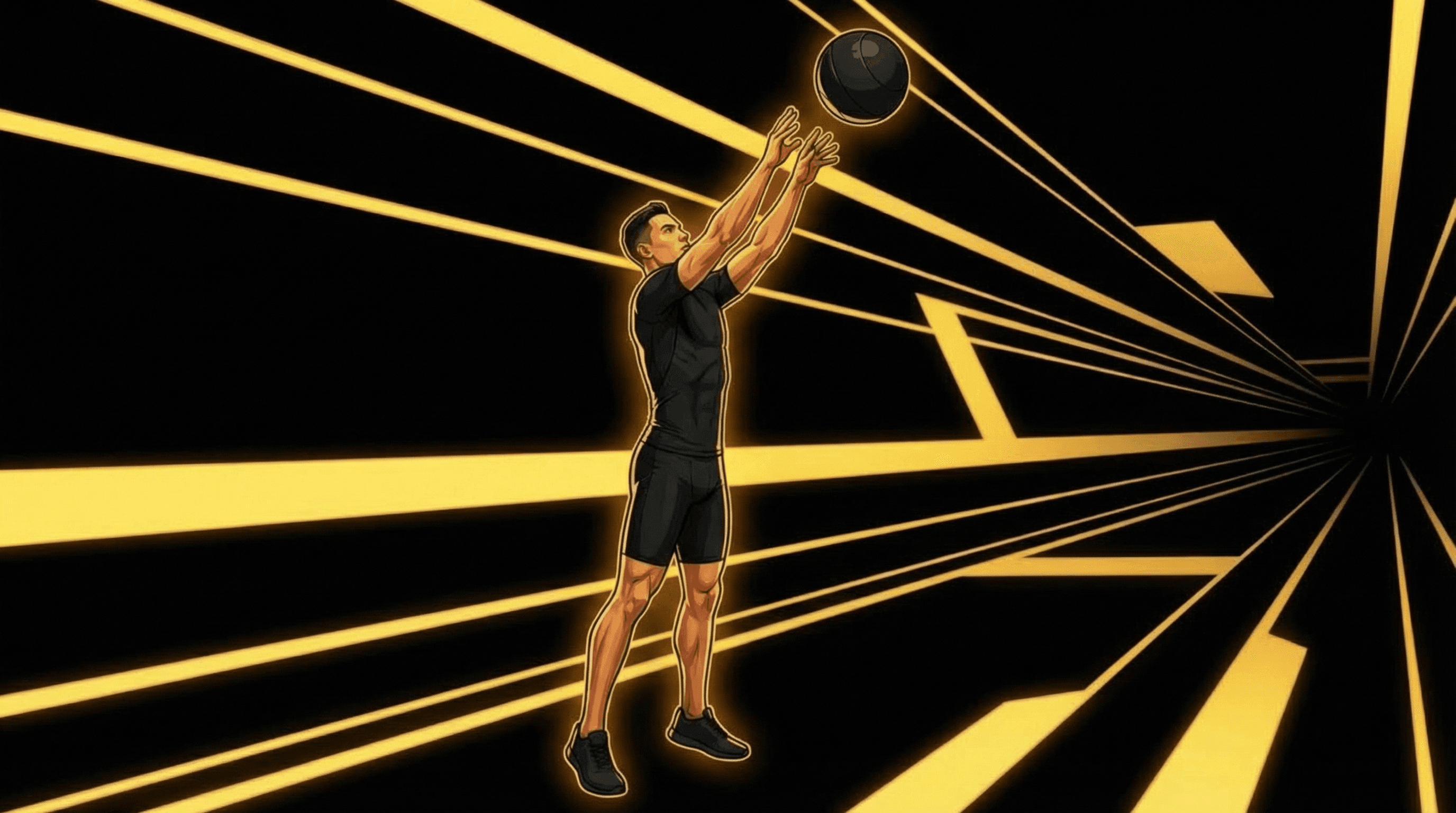
Wall balls are the final station in a HYROX® race, and they break more athletes than any other. Across 800,000+ race entries in the ROXBASE database, wall balls show the largest time sink of all eight stations. That's not because the movement is complicated. It's because 75 or 100 reps of a squat-to-throw at the end of a race that's already drained your legs, lungs, and grip is a different animal than doing them fresh in a gym.
This page covers everything: the exact weights, reps, target heights, and rules for every HYROX® division. The technique details that separate a 2-minute station time from a 4-minute one. The training methods that build wall ball endurance without wrecking your knees. And the alternatives you can use when you don't have a wall ball or a target.
One number to frame it all: the performance gap between the fastest and slowest wall ball times within the same division can exceed 3 minutes. That's a bigger swing than sled push, farmers carry, or rowing. If you want to protect your race time, you finish strong here.
Wall Balls in HYROX®: Reps, Weight & Rules
The wall ball station sits at position eight in the HYROX® race order. You arrive here after 8km of cumulative running, a sled push, a sled pull, burpee broad jumps, rowing, farmers carry, and sandbag lunges. Your legs have already absorbed thousands of reps of concentric and eccentric load. Now you face a high-rep squat-and-throw that demands coordination, leg drive, and sustained cardiovascular output.
Understanding the exact specifications before race day removes guesswork and lets you train with precision. The weight, rep count, target height, and ball size all vary by division. Get the details wrong in training and you'll build fitness for a different challenge than the one waiting for you.
For a complete breakdown of every division's specifications, the HYROX® wall ball weight guide covers all categories in detail.
Weight by Division
HYROX® assigns wall ball weights based on division and gender. The differences are significant enough to change your training approach.
| Division | Men's Weight | Women's Weight |
|---|---|---|
| Open Singles | 6 kg | 4 kg |
| Pro Singles | 9 kg | 6 kg |
| Doubles Open | 6 kg | 4 kg |
| Doubles Pro | 9 kg | 6 kg |
The jump from Open to Pro is 50% heavier for men (6 kg to 9 kg) and 50% heavier for women (4 kg to 6 kg). That extra 3 kg or 2 kg sounds minor in isolation. Multiply it by 100 reps with fatigued legs, and it adds 30-60 seconds to most athletes' station times. For a deep look at men's Pro weight and how to prepare, check out the men's wall ball weight breakdown.
Coach's Note: Train with the exact weight you'll use on race day. If you're in Open, resist the temptation to always train with the Pro ball. You'll build unnecessary fatigue and groove a different throwing rhythm. Save heavier balls for specific overload sessions, not daily practice.
75 vs 100 Reps
In Singles, men perform 100 wall ball reps in both Open and Pro. Women perform 100 reps in Open and 100 in Pro. In Doubles (Open and Pro), each partner completes 75 reps. That's 150 total reps for the team, but 25 fewer per person than a Singles racer.
The 25-rep difference matters more than you'd think. At a pace of roughly 1.5 seconds per rep, 25 extra reps cost about 37 seconds of work time. But it's not only the time under load. Those final 25 reps come at peak fatigue, when your squat depth starts to shallow out and your throws barely graze the target line. For Singles racers, this is where discipline pays off.
Doubles athletes get a built-in recovery window while their partner works, which keeps each athlete's heart rate from peaking as aggressively. If you're preparing for Doubles, 75 unbroken reps should be your training benchmark. Singles racers need to build the capacity for 100 reps, whether unbroken or in planned sets.
Target Height
The wall ball must hit at or above a marked target line on the wall. The standard HYROX® target height differs by gender:
- Men: 3 meters (approximately 9 feet 10 inches)
- Women: 2.70 meters (approximately 8 feet 10 inches)
These heights are the same across Open and Pro divisions. The target height doesn't change with weight, only gender determines the line. A throw that contacts the wall below the line doesn't count, and judges will signal a no-rep. That means you've wasted the energy of the squat and throw with nothing to show for it.
Accuracy under fatigue is the real skill. In training, it's easy to clear the line by half a meter. After 7 stations and 7 km of running, your throws drop. Aiming 15-20 cm above the line on every rep gives you a safety margin. For target height training cues and setup tips, the target height guide breaks it down.
Ball Size & Height
HYROX® uses soft-shell medicine balls (commonly called wall balls) with a standard diameter of roughly 35 cm (14 inches) regardless of weight. The 4 kg, 6 kg, and 9 kg balls are the same physical size. This means your catch position and hand placement don't change between divisions. Only the weight behind the throw changes.
If you're purchasing a wall ball for home training, match the 35 cm diameter. Smaller slam balls or traditional medicine balls have a different feel: they sit differently in the hands, behave differently on the catch, and don't replicate the HYROX® experience. The wall ball size and weight guide covers how to pick the right ball and what to avoid.
Height of the athlete matters, too. Taller athletes (180 cm+) throw a shorter relative distance to the target, which saves a fraction of energy per rep. Over 100 reps, that adds up. Shorter athletes need more explosive hip drive to reach the same line. Neither group has a decisive advantage; the demands shift, but the effort stays high.
Technique & Form
A technically sound wall ball rep uses less energy than a sloppy one. Over 100 reps, the difference between efficient and inefficient technique can be 45-90 seconds and a dramatically different level of muscular fatigue entering the final run. Technique isn't a nice-to-have at this station. It's a time saver.
The wall ball exercise combines a front squat with a vertical push/throw. Three phases repeat for every rep: the squat, the throw, and the catch. Each phase has specific cues that, when nailed, create a smooth rhythm you can sustain under fatigue. For a full technique walkthrough with common errors, see the wall ball exercise guide.
Squat, Throw & Catch
The squat is the foundation. Stand roughly an arm's length from the wall. Feet shoulder-width apart, toes turned out 15-30 degrees. Hold the ball at chest height with your hands under and slightly behind the ball, elbows pointing down, not flared.
Descend into a full squat: hip crease at or below the knee. Keep your torso upright. The moment you let your chest drop forward, the throw becomes an arm press instead of a leg-driven launch. That shift eats your shoulders alive by rep 40.
The throw begins from the bottom of the squat. As you drive up through your heels, transfer that force through your torso and into the ball. The arms finish the throw, but they shouldn't be doing the heavy lifting. Think of your legs as the engine and your arms as the steering wheel. Release the ball when your arms reach full extension overhead.
The catch is where most athletes leak energy. Let the ball drop back to chest height and absorb it with soft elbows as you begin the next squat descent. Don't catch it high and then re-position it. Don't let it slam into your chest while you're standing upright. Catch and descend should be one fluid motion. This "catch-into-squat" rhythm is what turns wall balls from a grinding slog into a sustainable cycle.
For a deeper breakdown of squat mechanics specific to wall balls, the wall ball squat technique guide covers foot position, depth cues, and common faults.
Wall Ball Shots: Full Movement
The term "wall ball shots" describes the complete movement: squat, throw, hit the target, catch, repeat. A single wall ball shot, when performed well, takes about 1.2-1.8 seconds. That's the tempo range where most athletes can sustain quality reps without burning out.
Here's the full movement sequence, broken down:
Setup
Ball at chest, feet set, eyes on the target line.
Squat Descent
Controlled drop, hip crease below knee, torso upright.
Drive & Throw
Explosive stand, transfer force into ball, release at full extension.
Catch & Absorb
Soft elbows, ball returns to chest, flow into next squat.
The wall between reps is the catch. Athletes who pause at the top, standing and holding the ball before squatting, add 0.3-0.5 seconds per rep. Over 100 reps, that's 30-50 seconds of dead time. Eliminating the pause is the single fastest technique improvement you can make.
Stand close enough to the wall that the ball returns to you without a forward lunge or a step back. If you're chasing the ball, you're too far away. If the ball bounces off the wall and hits you in the face, you're too close. An arm's length (roughly 60-80 cm) is the sweet spot for most athletes.
Breathing & Rep Schemes
Breathing falls apart first. Before your legs give out, before your arms burn, your breathing goes ragged and your reps slow to a crawl. Having a plan for when and how to breathe is the difference between a smooth 2:30 station time and a gasping 4:00.
The simplest breathing pattern: inhale on the descent, exhale on the throw. One breath per rep. This works well through about rep 50-60 for most trained athletes. After that, you may need two breaths per rep: one on the descent, one at the top before the throw. The key is to choose your pattern and stick with it. Don't let your breathing become reactive.
Rep schemes (how you break the total reps into sets) depend on your fitness level and target time:
| Strategy | Scheme | Best For | Estimated Time |
|---|---|---|---|
| Unbroken | 100 straight | Elite / well-trained | 2:00 - 2:30 |
| Two sets | 50-50 (5-10s rest) | Intermediate / race-fit | 2:30 - 3:00 |
| Four sets | 25-25-25-25 (5-8s rest) | Beginners / fatigued athletes | 3:00 - 3:45 |
| Managed sets | 20-20-20-20-20 (5s rest) | Conservative / first race | 3:30 - 4:15 |
The rest periods matter as much as the set sizes. Keep rest under 10 seconds. Stand with the ball at your chest, take 3-4 breaths, and go. If you put the ball down, picking it back up costs you time and mental momentum. The wall ball pacing and rep scheme guide covers how to choose the right strategy for your fitness level.
Coach's Note: Practice your rep scheme in training. Don't show up on race day planning to do 100 unbroken if you've never done more than 40 in practice. Your scheme should be something you've executed at least 3-4 times in training, after a conditioning session that mimics race fatigue.
Workouts for HYROX®
Wall ball fitness isn't built by doing wall balls alone. The station demands a specific blend: quad endurance for repeated squats, shoulder stamina for sustained overhead throwing, and cardiovascular capacity to maintain both while your heart rate sits at 85-90% of max.
Training for wall balls breaks into three categories: technique sessions (low volume, high focus), endurance sessions (high volume, race-pace or slower), and integrated sessions (wall balls combined with running or other stations). You need all three.
Here's a sample weekly wall ball training block for an athlete 8-12 weeks out from race day:
| Day | Session Type | Workout |
|---|---|---|
| Monday | Technique | 5 x 15 wall balls at race weight, 60s rest. Focus: catch-to-squat rhythm, zero pause at top. |
| Wednesday | Endurance | 3 x 40 wall balls at race weight, 90s rest. Goal: maintain consistent rep tempo across all sets. |
| Saturday | Integrated | 4 rounds: 400m run + 25 wall balls. Track total time and per-round splits. |
The integrated session is the most race-specific. Running before wall balls teaches your legs to produce force when they're already fatigued. That's the exact scenario you'll face at station eight.
Two workouts that build wall ball fitness without a wall ball or target:
- Goblet squat holds: 4 x 20 goblet squats with a 3-second pause at the bottom. Builds the positional strength and quad endurance the squat phase demands.
- Thruster intervals: 6 x 10 dumbbell thrusters at moderate weight, 45s rest. Thrusters mimic the squat-to-press pattern and train the same cardiovascular demand.
For a full library of wall ball workouts organized by training phase, the wall ball workout collection has sessions for every fitness level. And if you're building wall ball endurance toward the 100-rep benchmark, the 100-rep endurance training guide lays out a progressive plan.
Pro Tip: Track your time for a set of 50 unbroken wall balls every 2-3 weeks. This single test tells you more about your wall ball race readiness than any other metric. If that time is dropping, your training is working.
Alternatives
Not every gym has a wall ball target. Not every home gym has a wall ball. And some athletes have shoulder or knee limitations that make the standard wall ball shot painful. You still need to train the movement pattern, and you have good options.
The best wall ball alternatives replicate the same two demands: a loaded squat and a vertical push. The closer the substitute matches both, the better the carryover.
Full Equipment Alternatives
- Thrusters (barbell or dumbbell): Same squat-to-press pattern. Heavier loading possible. Missing the catch-and-absorb phase.
- Medicine ball cleans to press: Adds a floor-to-shoulder component. Good for power and grip endurance.
- Wall ball to lower target: If your gym has a wall but no marked target, use tape at the correct height.
Minimal Equipment Alternatives
- Goblet squat to overhead press (dumbbell or kettlebell): Removes the throw and catch but loads the same muscles.
- Squat jumps: Unloaded but trains the explosive hip drive needed for the throw phase.
- Bodyweight squat + push press (light object): A household substitute for raw beginners. Better than skipping the pattern.
ROXBASE contains 216 exercises with prioritized alternatives for every movement. When you indicate your available equipment during onboarding, the app substitutes the best alternative that targets the same muscle groups. Free weights are always prioritized over machines (barbell → dumbbell → kettlebell → bodyweight → machine). You don't need a HYROX® box to train for HYROX®.
One common question: can you use a slam ball or a standard medicine ball instead of a wall ball? Slam balls are denser and smaller, which changes the hand position and catch mechanics. Medicine balls are often harder-shelled and don't absorb into the hands the same way. Neither is a perfect substitute. The medicine ball vs wall ball comparison covers when each works and when it doesn't.
For a ranked list of the best alternatives by equipment tier, the wall ball alternatives guide walks through each option with specific sets, reps, and how to program them.
CrossFit vs HYROX®
CrossFit popularized the wall ball shot. Karen (150 wall balls for time) is one of the most infamous CrossFit benchmark workouts. If you've come to HYROX® from a CrossFit background, you already know the movement. But the context is different, and the standards aren't identical.
Here's how the two compare:
| Specification | CrossFit (Rx) | HYROX® Open | HYROX® Pro |
|---|---|---|---|
| Men's Weight | 9 kg (20 lb) | 6 kg | 9 kg |
| Women's Weight | 6 kg (14 lb) | 4 kg | 6 kg |
| Men's Target | 3.05 m (10 ft) | 3.00 m | 3.00 m |
| Women's Target | 2.74 m (9 ft) | 2.70 m | 2.70 m |
| Reps | Varies by WOD | 100 (Singles) / 75 (Doubles) | 100 (Singles) / 75 (Doubles) |
| Squat Depth | Hip crease below knee | Hip crease below knee | Hip crease below knee |
The target heights differ by 5 cm (men's) and 4 cm (women's). Small on paper, but it changes the release angle slightly. CrossFit Rx weights match HYROX® Pro weights. If you've been doing wall balls at Rx, you're already training at Pro-level load.
The bigger difference is context. In CrossFit, wall balls appear in short, intense workouts (often under 10 minutes). In HYROX®, you reach wall balls after 60-90+ minutes of racing. Your squat depth degrades. Your accuracy drops. Your breathing pattern falls apart. A CrossFit athlete who can crush Karen in 7:30 might struggle to finish HYROX® wall balls in 3:30 because the pre-fatigue is a different beast.
If you're transitioning from CrossFit, your technique is likely solid. What you need is the ability to execute that technique on tired legs. Practice wall balls at the end of long training sessions, not at the beginning. That's where the HYROX®-specific adaptation happens.
Rules & Standards
Knowing the rules prevents no-reps, which are the most expensive mistake at this station. Every no-rep costs you the energy of the rep plus the time of redoing it. Two or three no-reps across 100 reps can add 10-15 seconds to your station time. In a competitive field, that's the margin between podium and pack.
HYROX® wall ball standards are judged on three criteria:
- Squat depth: Hip crease must drop below the top of the knee at the bottom of each rep.
- Target contact: The ball must hit the wall at or above the marked target line.
- Catch and control: The athlete must catch the ball (it cannot hit the ground between reps) and maintain control before beginning the next rep.
If a judge calls a no-rep, you must perform that rep again. There is no penalty beyond the wasted time and energy. Judges will typically give a verbal signal ("no-rep" or a hand signal), and you should immediately reset and perform the next rep without arguing or hesitating.
The full rules and common penalties are covered in the HYROX® wall ball rules guide. For first-time racers, the wall ball beginner's guide walks through what to expect on race day.
Men's Weight
Men throw a 6 kg ball in Open divisions and a 9 kg ball in Pro divisions. These weights apply to both Singles and Doubles formats. There are no age-based weight adjustments in HYROX® (unlike some CrossFit masters divisions).
The 9 kg Pro ball demands meaningfully more shoulder endurance. At the release point, your arms are fully extended overhead and decelerating a 9 kg object on every catch. Over 100 reps, the cumulative shoulder load exceeds 900 kg of total catch-and-throw volume. Pro athletes need dedicated shoulder endurance work: high-rep overhead presses, thruster intervals, and extended wall ball sets at race weight.
For Open men, the 6 kg ball is light enough that shoulder fatigue is rarely the limiter. Leg endurance and cardiovascular capacity are the bottleneck. Your training should reflect that: more squats, more running-to-wall-ball transitions, less isolated upper body work. The men's wall ball weight guide covers how to structure training for each weight class.
Weight in kg
All HYROX® wall ball weights are standardized in kilograms. Here's the complete weight table for every division:
6 kg
100 reps (Singles) or 75 reps (Doubles). Target: 3.00 m.
4 kg
100 reps (Singles) or 75 reps (Doubles). Target: 2.70 m.
9 kg
100 reps (Singles) or 75 reps (Doubles). Target: 3.00 m.
6 kg
100 reps (Singles) or 75 reps (Doubles). Target: 2.70 m.
If you're shopping for a wall ball in pounds (common in the US market), the conversions are: 4 kg ≈ 8.8 lb, 6 kg ≈ 13.2 lb, 9 kg ≈ 19.8 lb. A 20 lb ball is close enough to 9 kg for Pro training. A 14 lb ball is the nearest common option for 6 kg, though it's slightly heavier. The complete weight guide by division includes these conversions and purchasing recommendations.
Total Throw Volume Per Race
An Open men's Singles racer throws 600 kg of total ball weight (6 kg × 100 reps). A Pro men's Singles racer throws 900 kg (9 kg × 100 reps). That 50% increase in total volume is why Pro wall ball times average 30-45 seconds slower than Open across our 800,000+ race entry database.
FAQ
Was this helpful?
More Training Guides
HYROX for Women: Training Plans, Weights & Race Guide
HYROX for women explained: women-specific weights, training plans, hormonal periodization, and race strategy using data from 325,000+ female athletes.
HYROX Race Day: Results, Checklist & Strategy Guide
Decode your HYROX results with age-group benchmarks, station-by-station split analysis, and a proven race day checklist to hit your personal best.
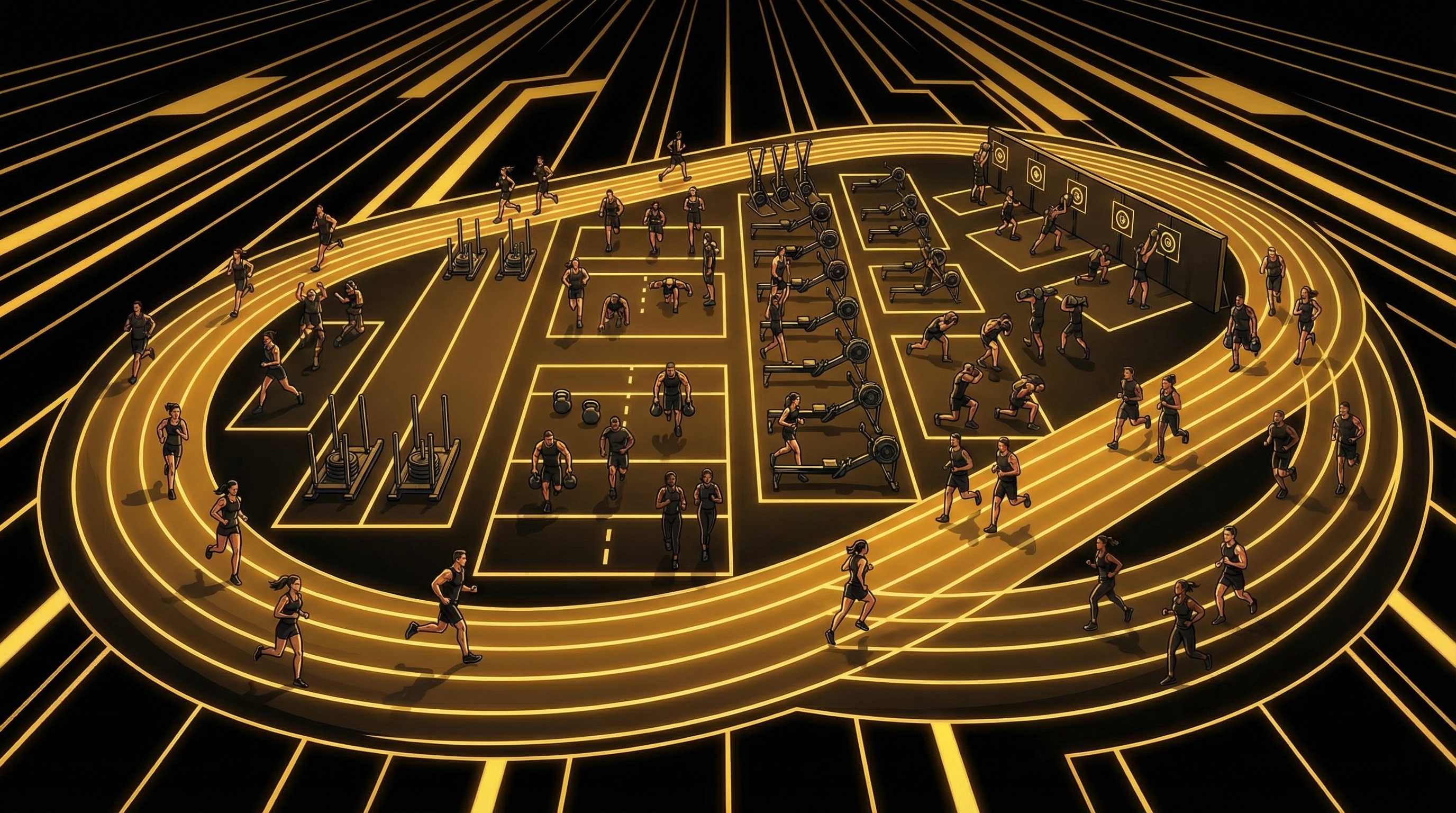
The Complete Hyrox Workout: All Exercises & Stations Explained
Master every Hyrox workout station, running split, and weight standard. Includes pacing strategy, periodization plans, and programming for all divisions.
Know Where You Stand
Reading is good. Knowing exactly where your minutes are hiding is better. Get your race breakdown and a plan that targets your weakest stations.
Analyze My Race