Hyrox SkiErg Guide: Technique, Pacing, Workouts & Training
Master the SkiErg for Hyrox with expert technique breakdowns, race-day pacing strategies, target splits, muscles worked, and progressive training workouts.
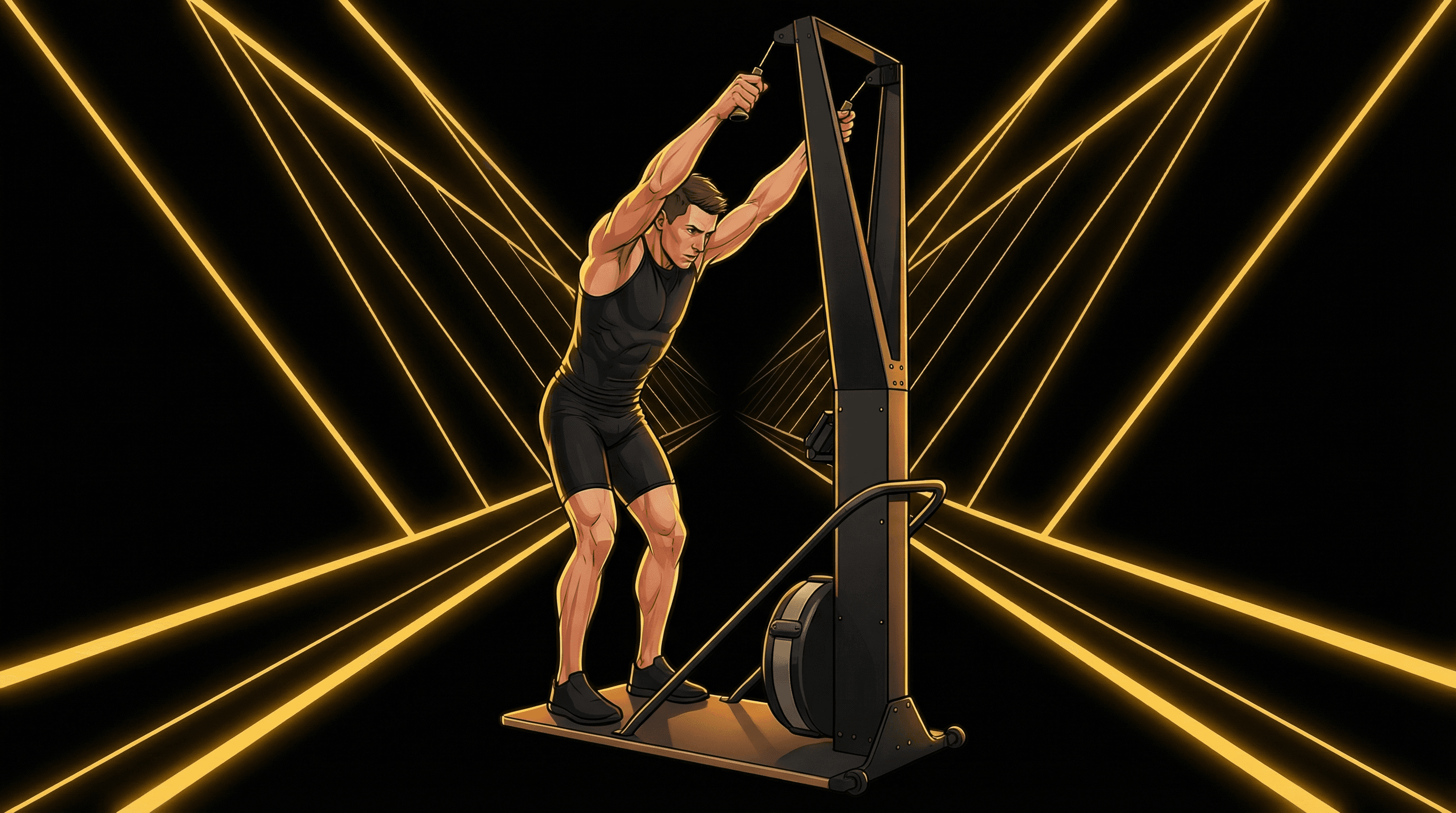
The SkiErg is the first station you hit after your opening 1km run in HYROX®, and it sets the tone for everything that follows. Burn too many matches here and you'll feel it at the sled push. Go too easy and you've left 15-30 seconds on the table that no other station can give back.
Across 800,000+ race entries in the ROXBASE database, SkiErg performance correlates strongly with cardiovascular fitness, which means the athletes who run well tend to ski well. But technique matters more than most people think. A smooth, hip-driven pull at 1:50/500m burns far less energy than a frantic arm-only thrash at the same pace.
This guide covers everything: how the Concept 2 SkiErg works, the technique that separates efficient athletes from struggling ones, pacing targets for every finish-time bracket, the muscles you're training, workouts that transfer directly to race day, and what to do if you don't have access to a machine. Every recommendation is grounded in real race data and exercise science.
What Is the SkiErg?
The SkiErg is a standing cardio machine that simulates the double-pole motion of Nordic skiing. You grab two handles overhead, drive them down through a powerful pull, and a flywheel connected to a chain provides resistance. The harder you pull, the more resistance you meet.
Unlike a treadmill or bike, the SkiErg demands upper-body endurance and core stability while taxing your cardiovascular system. It's one of the few machines that can spike your heart rate above 85% of max within 30 seconds of starting, yet it produces zero impact on your joints. That combination makes it a favorite for hybrid athletes and HYROX® competitors.
The machine was originally designed for cross-country ski teams looking for year-round training indoors. It's since spread to CrossFit boxes, commercial gyms, and home setups. If you've seen a tall, narrow machine bolted to a wall or sitting on a floor stand with two dangling handles, that's the SkiErg.
Concept 2 SkiErg Machine Explained
The Concept 2 SkiErg is the only version used in HYROX® competitions and the dominant model in gyms worldwide. Concept 2 (the same company behind the iconic rowing machine) builds it with an air-resistance flywheel, which means resistance scales with effort. Pull harder, get more resistance. Pull easier, get less. No manual adjustments mid-session.
The PM5 monitor tracks distance, pace (displayed as time per 500m), calories, stroke rate, and watts. For HYROX®, you'll watch pace per 500m and total distance. The damper setting (a lever on the flywheel cage) ranges from 1 to 10 and controls how much air enters the flywheel. Higher settings feel heavier per pull but don't necessarily make you faster. More on that in the technique section.
Two mounting options exist: wall-mounted and floor-stand. Both perform identically. The Concept 2 SkiErg review covers build quality, dimensions, and whether it's worth the investment for home training. The machine stands about 215cm tall and takes up minimal floor space (about 0.5m × 1.2m), making it one of the most space-efficient cardio machines you can own.
SkiErg in HYROX®: Distance & Rules
In HYROX®, you ski 1,000 meters on the SkiErg. It's the first station, placed after the opening 1km run. In Doubles, each partner completes 500m. The PM5 monitor counts down from 1,000m (or 500m in Doubles) to zero, and you can't leave the station until the screen reads 0.
The official rules are straightforward: stand in front of the machine, grab the handles, and pull until you hit zero. There are no penalties for technique variations. You can use a standing pull, a slight hip hinge, or even sit down (though sitting is slower for almost everyone). The damper setting is usually preset by event organizers, but athletes can adjust it.
What makes the SkiErg tactically interesting is its position. You arrive from a 1km run with an elevated heart rate. Ripping into 1,000m of upper-body pulling at maximum effort will spike your heart rate further, and you still have 7 more runs and 7 more stations ahead. Smart athletes treat the SkiErg as a controlled burn, not an all-out sprint. Check what pro athletes do at the SkiErg station for race-specific tactics that save energy without sacrificing pace.
Coach's Note: The SkiErg is a "cardiovascular transfer" station. Your running fitness directly impacts your SkiErg performance. Athletes who can hold a 4:45/km running pace typically complete the 1,000m SkiErg in under 4:00. Prioritize running fitness and the SkiErg comes along for the ride.
SkiErg Technique & Form
Good SkiErg technique is the difference between a 3:40 and a 4:10 over 1,000m, without any change in fitness. That 30-second gap comes from mechanical efficiency: getting more meters per pull while spending less energy per stroke.
The most common error is treating the SkiErg as an arm exercise. It isn't. About 60% of your power should come from your hips and core, with your arms acting as the connection between your body and the handles. Think of it like a kettlebell swing flipped upside down: the hips generate force, and the arms transfer it.
For a detailed breakdown of drills that build this pattern, read our SkiErg technique drills guide. Below, we'll cover the three phases of each stroke and the mistakes that cost you the most time.
Arm Pull, Hip Hinge & Drive Phase
Phase 1: The Reach. Stand tall with your feet hip-width apart, about 30cm behind the machine. Reach both arms overhead, extending fully. Your body should form a slight arc from fingertips to heels. Don't lean forward yet. This starting position loads your lats and core like pulling back a slingshot.
Phase 2: The Drive. Initiate the pull by bracing your core and hinging at the hips. As your torso folds forward (roughly 15-20 degrees), your arms pull the handles down in a smooth arc. Your elbows stay slightly bent but not excessively. The power sequence is hips → core → lats → arms. Your hands should pass your knees as your hip hinge reaches its deepest point (about 30-40 degrees of forward lean).
Phase 3: The Finish & Return. At the bottom, your hands are near your thighs and your torso is hinged forward. Don't collapse. Snap upright from the hips, letting your arms float back overhead as the handles recoil. The return phase should take slightly longer than the drive phase (roughly 60/40 split). Rushing the return wastes energy and ruins your rhythm.
The damper setting affects how each phase feels. A setting of 5-7 works for most HYROX® athletes. Lower settings (1-4) favor fast stroke rates and lighter pulls. Higher settings (8-10) reward powerful, slow strokes. If you're under 70kg, start at 5. Over 85kg, try 6-7. Adjust from there based on what produces your best pace at a sustainable stroke rate of 30-38 pulls per minute.
Common Mistakes
How do you use a SkiErg correctly? Stand with feet hip-width apart, reach overhead, then drive the handles down by hinging your hips and engaging your lats. The most common mistake is pulling with straight arms and no hip hinge, which turns a full-body movement into an arm isolation exercise that fatigues you in under 200 meters.
Mistake 1: All arms, no hips. If your lower back aches after 500m but your legs feel fresh, your hips aren't working. Fix: exaggerate the hip hinge in your next session. Think "bow to the machine" on every pull.
Mistake 2: Standing too close. When your feet are directly under the machine, you can't hinge properly. Stand 25-35cm back. This gives your body room to fold forward and generate force through a full range of motion.
Mistake 3: Death grip. Squeezing the handles with a white-knuckle grip fatigues your forearms within 2 minutes. Hook the handles with your fingers and let the shape of the grip do the work. Your grip needs to last through sled pulls, farmers carries, and wall balls later in the race.
Mistake 4: Sprinting the first 200m. Starting at a 1:30/500m pace when your sustainable pace is 1:50/500m creates an oxygen debt you'll pay for during the second 500m. The result? A net slower time and a higher heart rate entering your second run. For a more complete walkthrough, our guide on how to use the SkiErg covers setup, common errors, and progression tips for beginners.
Pacing Strategy for 1,000m in HYROX®
Pacing the SkiErg in HYROX® is different from pacing a standalone 1,000m test. In a gym test, you can collapse after you finish. In HYROX®, you step off the SkiErg and immediately run another kilometer. The cost of going too hard isn't a slower SkiErg time; it's a slower next run, a slower sled push, and a compounding energy deficit that follows you through 7 remaining stations.
The best approach for most athletes: negative split or even split. Start 2-3 seconds per 500m slower than your target average, settle in by 300m, then push the final 200m. Across race data from 700,000+ athletes, the ones who negative-split the SkiErg tend to hold steadier run paces throughout the rest of the race. The ones who go out 10% too fast show an average run-pace degradation of 8-12 seconds per kilometer by the final laps.
Your target pace depends on your overall finish-time goal. The table below provides benchmarks. For a deeper breakdown with interval-by-interval pacing plans, read the SkiErg 1,000m pacing guide.
Target Splits by Finish Time
| HYROX® Finish Time Goal | SkiErg 1,000m Target | Pace per 500m | Stroke Rate (SPM) |
|---|---|---|---|
| Sub-1:00:00 (Elite) | 3:10-3:25 | 1:35-1:42 | 36-42 |
| 1:00-1:15:00 (Advanced) | 3:25-3:50 | 1:42-1:55 | 34-38 |
| 1:15-1:30:00 (Intermediate) | 3:50-4:20 | 1:55-2:10 | 30-36 |
| 1:30-1:45:00 (Developing) | 4:20-5:00 | 2:10-2:30 | 28-34 |
| 1:45:00+ (Finishing) | 5:00-5:30+ | 2:30-2:45 | 26-32 |
These numbers aren't pulled from thin air. They're derived from the ROXBASE race database, matching station times against overall finishing times for Open division athletes. Your personal targets may shift slightly based on your strengths (if you're a strong runner, you can afford a slightly easier SkiErg pace and make time up on the run segments).
For a visual reference with pace bands by fitness level, see the SkiErg pace chart.
Race-Day Rule: Your SkiErg pace in HYROX® should feel like a 7 out of 10 effort. Not easy, but not redlining. Save the 9/10 effort for the final 200m if you have gas left. The 30 seconds you gain by going all-out at the start will cost you 60+ seconds across the remaining 7km of running.
SkiErg Muscles Worked
What does the SkiErg work? The SkiErg trains your lats, triceps, core, glutes, and hip flexors in a coordinated pulling pattern. It's one of the few cardio machines that prioritizes the upper body and posterior chain while simultaneously taxing your aerobic system.
Primary movers (generate the most force):
- Latissimus dorsi: The main engine. Your lats pull the handles from overhead to your hips. If your lats are weak, your SkiErg pace ceiling is low.
- Triceps: Extend the elbows during the drive phase. They work hardest in the bottom third of the pull.
- Rectus abdominis and obliques: Transmit force from your upper body to your hips. Without a braced core, power leaks and your pace drops.
Secondary movers (support and stabilize):
- Glutes and hamstrings: Power the hip hinge. Stronger hip drive means more meters per pull.
- Posterior deltoids: Initiate the pull from the overhead position.
- Forearm flexors: Grip the handles. They fatigue faster than you'd expect over 1,000m.
- Erector spinae: Stabilize the spine during the hinge. Weak spinal erectors lead to a rounded back and lost power.
The SkiErg's muscle recruitment pattern makes it a strong complement to running (which is quad and calf dominant). Training both means you build balanced anterior/posterior strength. For a complete anatomical breakdown with targeted accessory exercises, read SkiErg muscles worked: anatomy guide.
One underappreciated benefit: SkiErg training builds the same lat and core endurance you need for sled pulls and wall balls later in the race. The 1,000m of skiing isn't just station 1; it's a warm-up for the pulling and pressing demands of stations 2 through 8.
MUSCLE ENGAGEMENT: SKIERG VS ROWER
The SkiErg uses roughly 60% upper body / 40% lower body muscle contribution. The rower flips this to approximately 35% upper body / 65% lower body. This is why combining both in your training creates more complete HYROX® preparation than relying on one alone.
SkiErg Benefits
The SkiErg delivers 5 specific benefits that matter for HYROX® athletes. Not vague "improved fitness" claims. Measurable, race-relevant advantages.
1. Upper-body cardio endurance without impact. Running builds leg cardio. The SkiErg builds upper-body cardio. Over 1,000m, your heart rate can sustain 85-92% of max while your legs rest. This means you train your aerobic system harder in a single week without adding more running volume (and the joint stress that comes with it).
2. Posterior chain strength in a cardio context. Most strength work is done in isolated sets with rest periods. The SkiErg loads your lats, core, and glutes under continuous cardiovascular stress, which mirrors the demands of HYROX®. You don't need strong lats at rest. You need strong lats at 170bpm.
3. Grip endurance training. Holding the handles for 3-5 minutes straight builds forearm endurance you'll use during sled pulls (50m of pulling a loaded sled by rope) and farmers carries (200m with heavy kettlebells or dumbbells). Athletes who skip SkiErg training often report grip failure at later stations.
4. Low injury risk. The SkiErg produces zero ground-impact force. No eccentric loading on tendons. No joint compression. Athletes recovering from shin splints, knee pain, or plantar fasciitis can train the SkiErg at full intensity while their lower body heals. It's one of the safest high-output cardio tools available.
5. Mental race rehearsal. The SkiErg is the first station. Practicing it regularly means you arrive at race day with a familiar movement, a known pacing plan, and zero anxiety about the machine. That confidence compounds across the entire race.
For 7 more detailed benefits with training applications, read the full SkiErg benefits breakdown.
SkiErg Workouts for HYROX®
Training the SkiErg for HYROX® requires two types of sessions: intervals that push your pace ceiling higher, and endurance sessions that build your ability to sustain effort across the full 1,000m after a run. Doing only one type leaves you half-prepared.
Aim for 2-3 SkiErg sessions per week during a HYROX® training block. One interval session, one endurance session, and one optional technique-focused session. For a ready-made 4-week progression, the 4-week SkiErg plan for HYROX® lays out every session. Below are sample workouts for each category.
Interval Workouts
Intervals improve your 500m pace, which directly lowers your 1,000m time. The goal: spend time at or above race pace so that race pace feels controlled, not maximal.
| Workout | Structure | Target Pace | Rest |
|---|---|---|---|
| 500m Repeats | 4 × 500m | Race pace or 2-3 sec/500m faster | 2:00 between reps |
| 250m Sprints | 6 × 250m | 5-8 sec/500m faster than race pace | 1:30 between reps |
| Descending Ladder | 500m, 400m, 300m, 200m, 100m | Get faster each interval | 1:00 per 100m completed |
| Race Simulation | 1km run + 1,000m SkiErg × 2 rounds | Goal race pace for both | 3:00 between rounds |
The Race Simulation workout is the most HYROX®-specific. It teaches your body to ski at target pace with an elevated heart rate from running. If you only do one SkiErg workout per week, make it this one.
For 5 more detailed SkiErg interval workouts with progression guidelines, see 5 SkiErg workouts for HYROX®.
Endurance Sessions
Endurance sessions build your aerobic base on the SkiErg and teach you to maintain technique when fatigued. These are lower intensity but longer duration.
Workout 1: Steady-State 2,000m. Set a pace 8-12 seconds per 500m slower than your race target. Ski 2,000m without stopping. Focus on identical stroke mechanics from the first pull to the last. If your pace drifts more than 3 seconds, you started too fast.
Workout 2: 20-Minute Continuous Ski. Set the monitor to time rather than distance. Ski for 20 minutes at a pace that lets you hold a broken conversation. Track total distance. Aim to add 50-100m to your total each week for 4 weeks. This builds the aerobic engine that supports every station in HYROX®.
Workout 3: Mixed-Modal Endurance. 3 rounds of: 500m SkiErg + 500m Row + 400m Run. No rest between movements. Keep each piece at 70-75% effort. This teaches your body to transition between movement patterns, which is the core demand of HYROX®.
These SkiErg exercises build the base. The intervals sharpen the blade. You need both.
Alternatives (No Machine)
Not every gym has a SkiErg. Only about 35% of commercial gyms carry one. If you don't have access, you have two paths: find a gym that does for occasional practice, or train the same movement patterns with alternative exercises that target the same muscles.
No alternative perfectly replicates the SkiErg. But several come close enough to build the fitness you need.
Best Alternatives (Equipment)
- Banded lat pulldowns (standing): Attach a band overhead, pull down with the same hip-hinge pattern. 4 × 30 seconds on / 30 seconds off.
- Dumbbell pullovers (high rep): 3 × 20 reps with a light dumbbell. Targets lats and triceps through a similar range of motion.
- Cable rope slams: Standing cable machine with a rope attachment. Pull from overhead to hips. 5 × 15 reps.
Best Alternatives (Bodyweight)
- Burpees (for cardio + hip hinge pattern): 5 × 1:00 on / 1:00 off. Matches the cardiovascular demand.
- Inchworm walkouts: 3 × 10 reps. Loads core and lats through an eccentric stretch.
- Slam ball throws: 5 × 12 reps with a 6-10kg ball. The closest movement match to the SkiErg pull pattern.
Slam ball throws are the single best SkiErg alternative. The overhead-to-floor movement mirrors the SkiErg pull path, and the explosive hip hinge develops the same power pattern. If you have access to a slam ball, use it.
ROXBASE automatically substitutes SkiErg exercises with the best available alternative based on your equipment profile. The app's exercise library contains 216 movements with prioritized alternatives, so you'll always get the closest-matching exercise for your setup. For a complete list of substitutions ranked by effectiveness, read SkiErg alternatives: training without the machine.
SkiErg vs Rower in HYROX®
Both the SkiErg and the rower appear in HYROX® (SkiErg at station 1, rowing at station 5), and both test cardiovascular endurance over 1,000m. But they train your body differently, and understanding the distinction helps you allocate training time.
| Factor | SkiErg | Rower |
|---|---|---|
| HYROX® Station | Station 1 (after run 1) | Station 5 (after run 5) |
| Primary Muscles | Lats, triceps, core (upper body dominant) | Quads, glutes, lats (lower body dominant) |
| Body Position | Standing | Seated |
| Muscle Split | ~60% upper / 40% lower | ~35% upper / 65% lower |
| Impact on Running | Low (legs rest) | Moderate (legs work hard) |
| Typical 1,000m Time (Open) | 3:30-5:00 | 3:20-4:45 |
| Heart Rate Recovery | Moderate (upper body fatigue) | Slower (full body fatigue) |
The SkiErg is more forgiving on your legs because you're standing and the pulling motion is upper-body dominant. This makes it a better early-race station; your legs are fresh and the SkiErg keeps them that way. The rower, at station 5, comes after the sled push, sled pull, and burpee broad jumps. By that point, your legs are already fatigued, and sitting down actually provides brief relief.
For training, include both machines weekly. If you only have time for one, the rower builds more transferable full-body fitness. But for SkiErg-specific pacing and technique, there's no substitute for time on the actual machine.
For a deeper side-by-side analysis with training recommendations, read SkiErg vs rower in HYROX®. If you're choosing between the two for a home gym purchase, the SkiErg vs rowing comparison covers calorie burn, space requirements, and which delivers more for HYROX® preparation.
How to Use the SkiErg - Step by Step
How do you use a SkiErg machine? Set the damper between 5 and 7, stand 25-35cm behind the handles, reach overhead, and pull down through a coordinated hip hinge and arm drive. The machine counts meters on the monitor. Here's the full setup, from unboxing to your first 1,000m.
Step 1: Position yourself. Stand facing the machine with feet hip-width apart. Your toes should be 25-35cm behind the machine's base (floor model) or 25-35cm out from the wall (wall-mounted). Too close and you can't hinge. Too far and you lose power at the top of the pull.
Step 2: Set the damper. The damper dial sits on the right side of the flywheel cage. Turn it to 5-7 for general HYROX® training. A setting of 5 favors lighter, faster strokes. A setting of 7 favors heavier, slower strokes. Neither is "better." Experiment during training to find the setting where your pace is fastest at a stroke rate you can sustain for 3-4 minutes.
Step 3: Set the monitor. Press the "Menu" button on the PM5. Select "New Workout" → "Single Distance" → 1,000m. The screen will count down from 1,000m to 0. For training, you can also use "Just Ski" mode for open-ended sessions.
Step 4: Grab the handles. Reach overhead and grab both handles with a relaxed grip. Wrap your fingers around the handles without squeezing. Your palms face inward.
Step 5: Initiate the pull. Brace your core. Hinge your hips back 15-20 degrees. Simultaneously pull both handles down in a sweeping arc, driving your elbows toward your hips. Your hands should travel from overhead to thigh level in one smooth motion. Exhale on the drive.
Step 6: Return and repeat. Stand tall, letting the handles float back overhead as the chain recoils. Don't rush this phase. Take a split-second to reset your posture before the next pull. Inhale on the return.
Step 7: Find your rhythm. After 5-10 strokes, settle into a consistent stroke rate. For 1,000m in HYROX®, aim for 30-38 strokes per minute depending on your size and fitness level. Bigger athletes tend to ski at lower stroke rates with more power per pull. Smaller athletes often benefit from slightly higher rates.
If you're brand new to the machine, start with the SkiErg for beginners guide for a gentler progression. For more advanced technique refinement, revisit the technique drills guide.
Pro Tip: During your first 3-5 SkiErg sessions, ignore pace entirely. Focus only on the hip hinge pattern and a relaxed grip. Once the movement feels natural, start chasing pace targets. Technique first, speed second. Always.
FAQ: SkiErg for HYROX®
Was this helpful?
More Training Guides

HYROX for Women: Training Plans, Weights & Race Guide
HYROX for women explained: women-specific weights, training plans, hormonal periodization, and race strategy using data from 325,000+ female athletes.

HYROX Race Day: Results, Checklist & Strategy Guide
Decode your HYROX results with age-group benchmarks, station-by-station split analysis, and a proven race day checklist to hit your personal best.

The Complete Hyrox Workout: All Exercises & Stations Explained
Master every Hyrox workout station, running split, and weight standard. Includes pacing strategy, periodization plans, and programming for all divisions.
Know Where You Stand
Reading is good. Knowing exactly where your minutes are hiding is better. Get your race breakdown and a plan that targets your weakest stations.
Analyze My Race