What Is Hyrox? The Complete Guide to the World's Fitness Race
What is Hyrox? Learn the race format, all 8 workout stations, divisions, weights, and finish times - plus how to train for your first event in 12-16 weeks.
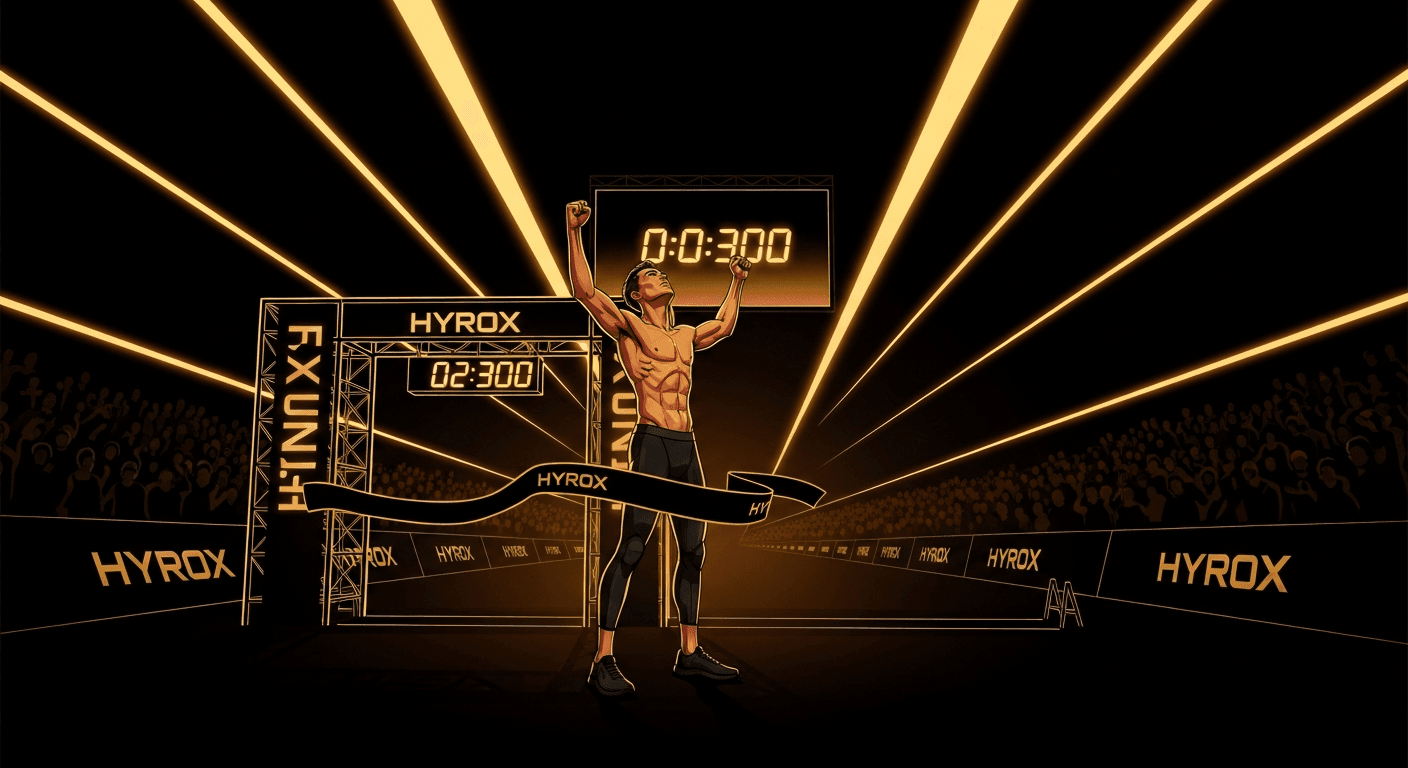
HYROX® is a fitness race. Eight 1-kilometer runs, each followed by a functional workout station, back to back, against the clock. Since its founding in 2017 and first race in Hamburg in 2018, it has grown to 707,000+ registered athletes across 30+ countries. In season 23/24 alone, over 200,000 new athletes entered a HYROX® event for the first time.
That growth isn't accidental. HYROX® fills a gap that running races, CrossFit competitions, and obstacle course events left wide open: a standardized, repeatable fitness competition where anyone can race, every course is identical, and your time is directly comparable to every other athlete worldwide.
This page covers everything you need to know about HYROX®. The race format. The rules. The weights. How it compares to CrossFit, Spartan, and DEKA FIT. Who it's built for. And how to train for your first (or fastest) race. If you want the deep dive on how HYROX® grew from a single German event into a global series, we've covered that separately.
The Race Format
A HYROX® race is 8 rounds. Each round pairs a 1-kilometer run with one functional workout station. You complete them in a fixed order, with no variation between events. A race in London uses the same distances, same weights, and same station sequence as a race in Dallas, Sydney, or Munich.
The total distance on foot: 8 kilometers of running plus the movement distances of each station. Most athletes finish in 60 to 100 minutes. The current HYROX® world records sit around 51 minutes for men and 55 minutes for women in the Pro division.
Your clock starts when you cross the start line and doesn't stop until you finish the last Wall Ball rep. Transitions between running and stations count. Every second matters, which is why experienced racers plan their pacing, transitions, and station strategy before they set foot on the course.
If you want a full breakdown of every station, rep count, and tactical consideration, read our complete HYROX® race format guide.
8 Stations + 8 Runs
Every HYROX® race follows the same sequence. No surprises. No random workouts. Here's what you'll face, in order:
SkiErg
1,000 meters of double-pole pulling. This station rewards athletes with a strong posterior chain and efficient rhythm. It's early in the race, so resist the urge to redline.
Sled Push
50 meters of loaded pushing. Bodyweight matters here. Lighter athletes face a proportionally harder effort since the sled weight is fixed.
Sled Pull
50 meters of rope pulling from a fixed position. This station shows the largest improvement potential among returning athletes, according to ROXBASE race data.
Burpee Broad Jumps
80 meters of forward progress through burpees. This station has the widest performance spread of any, meaning the gap between good and poor technique is massive.
Rowing
1,000 meters on a Concept2 rower. A cardiovascular station where your running fitness transfers directly. Controlled pace wins here.
Farmers Carry
200 meters carrying a pair of heavy kettlebells or dumbbells. This is the most consistent station across all athletes, with the smallest performance variance.
Sandbag Lunges
100 meters of walking lunges with a heavy sandbag on your shoulders. Your legs are fatigued from 7 km of running by this point. Pacing discipline is everything.
Wall Balls
75 reps (Women Open) or 100 reps (Men Open). This is the #1 time sink across all divisions. High-rep endurance separates fast finishers from everyone else.
Running accounts for the majority of your total race time. A 30-second improvement per kilometer saves 4 minutes across the 8 km. That's often more than you'd gain from optimizing any single station. But stations are where poor preparation punishes you. The sled push and Wall Balls alone can cost 10+ minutes if you're undertrained.
Coach's Note: Among the 800,000+ race entries ROXBASE has analyzed, Wall Balls consistently appear as the biggest time sink. But Burpee Broad Jumps show the widest spread between fast and slow athletes. That means technique work on BBJs offers one of the highest returns on training time.
Divisions: Singles, Doubles, Pro, Relay
HYROX® runs five main divisions, each with different weight standards and competitive expectations. Across all race entries, 66% of athlete-participations are in Doubles formats, with 34% racing Singles. Most athletes start with a Doubles partner, then move to Singles once they know the race.
Singles Open
The most popular singles division. Standard weights. No qualifying time required. This is where 25-44 year-olds (~76% of all athletes) compete most frequently.
Singles Pro
Heavier station weights. Requires a qualifying time. Pro athletes chase World Championship slots and prize money at Elite events.
Doubles Open & Pro
Two athletes, same course. You alternate runs and split stations however you choose. A popular entry point: both partners run all 8 km together while splitting the station work. Read the full Doubles strategy guide for tactical pairings.
Relay
Teams of four, each completing two full rounds (1 run + 1 station). Great for corporate teams, gym squads, or friend groups. More on this in our HYROX® Relay breakdown.
Mixed Doubles is a distinct category as well, pairing one male and one female athlete. Age group rankings allow athletes to compare against peers in their decade (16-24, 25-29, 30-34, and so on). For a complete breakdown of every HYROX® age group and division, we've built a dedicated guide.
Rules & Weight Standards
HYROX® uses fixed, standardized weights at every event worldwide. The sled you push in Chicago weighs the same as the one in Berlin. This is what makes HYROX® times universally comparable, a feature no obstacle race or CrossFit competition can match.
Rules are straightforward but strictly enforced. Movement standards are judged. Penalties exist for cutting corners. And understanding the full HYROX® rulebook before your first race removes any chance of a surprise on race day.
Weights by Division & Gender
Station weights differ by gender and by Open vs. Pro division. Here are the standard loads:
| Station | Men Open | Women Open | Men Pro | Women Pro |
|---|---|---|---|---|
| Sled Push | 152 kg | 102 kg | 202 kg | 152 kg |
| Sled Pull | 103 kg | 78 kg | 153 kg | 103 kg |
| Burpee Broad Jumps | Bodyweight | Bodyweight | Bodyweight | Bodyweight |
| Farmers Carry | 2 × 24 kg | 2 × 16 kg | 2 × 32 kg | 2 × 24 kg |
| Sandbag Lunges | 20 kg | 10 kg | 30 kg | 20 kg |
| Wall Balls | 6 kg / 100 reps | 4 kg / 75 reps | 9 kg / 100 reps | 6 kg / 100 reps |
SkiErg and Rowing are distance-based (1,000 m each) with no weight variable. The weights above are total sled weight (sled + plates), not just the added load.
Pro division is a significant step up. The sled push jumps 50 kg heavier per gender. Wall Balls go from 4 kg to 6 kg for women and 6 kg to 9 kg for men, with women also doing 100 reps instead of 75. These differences add up to 8-15 minutes on race time for most athletes.
Key Detail: Sled weights include the sled itself. Sled weight can feel different at different venues due to floor surface and sled condition, even though the loaded weight is identical. Training at heavier-than-race weight prepares you for worst-case friction.
Penalties, Time Caps & Scoring
HYROX® scoring is simple: fastest total time wins. Your clock includes all running, all stations, and all transitions. There's no separate transition timer. If you spend 45 seconds walking between the run lane and a station, that's 45 seconds on your final time.
Movement standards are judged at every station. Wall Balls must hit a marked target height. Lunges require a trailing knee to touch (or nearly touch) the ground. Sled pushes and pulls must cross the full 50 m line. If you fail a rep, the judge won't count it, costing you time to redo it.
Penalty laps exist for specific infractions (like cutting the course or skipping markers on Burpee Broad Jumps). These add distance to your run, typically 5-meter loops.
Time caps vary by event but are generous enough that finishing isn't a concern for most athletes. The cap is designed to keep the venue running on schedule, not to disqualify participants. If you can run 8 km and move through each station at any pace, you'll finish well inside the cap.
HYROX® vs CrossFit
No, HYROX® is not CrossFit. They share surface-level similarities (functional movements, timed competition), but the race structure, training demands, and competitive model are fundamentally different. Roughly 54% of HYROX® athletes are male and 46% female, with a core age range of 25-44. Many come from running, gym training, or team sports backgrounds, not from CrossFit boxes.
The biggest difference: HYROX® is the same workout every time. CrossFit competitions use unknown or varied workouts. This makes HYROX® endlessly trainable. You know exactly what's coming. You can measure progress from race to race. And your time is comparable to every other athlete who has ever raced HYROX®, anywhere in the world.
For a deep side-by-side breakdown, read our HYROX® vs CrossFit comparison.
Training, Competition & Community
HYROX®
- Fixed format: same 8 stations, same distances, same weights, every race
- Endurance-dominant: 60-90+ minutes of sustained effort
- Running is the single biggest time factor (8 km total)
- Open to all. No qualifying needed for Open division
- Results comparable worldwide, season over season
- Training focus: aerobic base, muscular endurance, pacing strategy
CrossFit Competition
- Varied format: workouts change per event, often unknown until day-of
- Broad demands: heavy strength, gymnastics, short and long conditioning
- Requires high skill ceiling (Olympic lifts, muscle-ups, handstands)
- Competitive pathway: Open → Quarterfinals → Semifinals → Games
- Results aren't directly comparable across different competitions
- Training focus: strength, skill acquisition, metabolic conditioning
CrossFit training develops broader fitness across more domains. HYROX® training develops deep fitness in a specific domain: sustained work output over 60-90 minutes with mixed running and functional movements.[1] Neither is "better." They test different things.
Community-wise, HYROX® events feel like mass-participation running races. Thousands of athletes on the course at once. Loud music. Spectator-friendly venues. CrossFit competitions (outside the CrossFit Games) are typically smaller, gym-based events with a different atmosphere.
One more difference worth noting: HYROX® has a low skill barrier. Every station uses fundamental movements. You don't need to learn a snatch, a muscle-up, or a pistol squat. If you can run, push, pull, squat, and lunge, you can race HYROX®.
HYROX® vs Other Competitions
HYROX® sits in a unique position: it's indoor, standardized, and endurance-focused. That separates it from obstacle course races (outdoor, variable terrain, skill-based obstacles), DEKA FIT (similar concept, different execution), and even marathon running (which we've compared in detail). Here's how it stacks up against the two most common comparisons.
HYROX® vs DEKA FIT
DEKA FIT, created by Spartan Race, uses 10 zones of functional fitness paired with running intervals. The concept is similar to HYROX®, but the execution differs in key ways.
HYROX® runs are longer (1 km per round vs. shorter intervals in DEKA). HYROX® weights are heavier. And HYROX® has a significantly larger competitive database: 707,000+ athletes vs. DEKA's smaller footprint. That means HYROX® times carry more weight for benchmarking.
DEKA FIT also runs in Spartan venues and gyms, while HYROX® rents large arenas and convention centers. The event experience is different. HYROX® feels like a stadium event. DEKA feels like a gym competition.
For the full comparison with specific station-by-station differences, read our HYROX® vs DEKA FIT breakdown.
HYROX® vs Spartan Race
Spartan Race and HYROX® attract overlapping audiences but deliver completely different experiences. Spartan is outdoor, on trails, with 20-30 obstacles per race. Conditions change with weather, terrain, and course design. No two Spartan races are alike.
HYROX® is indoor, climate-controlled, and identical every time. Your HYROX® time from a November race in Manchester is directly comparable to your July race in Miami. That repeatability is what makes structured training possible.
| Factor | HYROX® | Spartan Race |
|---|---|---|
| Environment | Indoor arena | Outdoor trail |
| Course Consistency | Identical worldwide | Varies every event |
| Skill Requirement | Low (run, push, pull, squat) | Moderate-High (climbing, crawling, carries) |
| Typical Duration | 60-100 min | 45-180 min (varies by distance) |
| Time Comparability | Universal | Only within same course |
| Injury Risk Profile | Low (controlled surface) | Higher (terrain, obstacles) |
Spartan excels at adventure and unpredictability. HYROX® excels at measurable performance. If you want to see improvement in hard numbers from one event to the next, HYROX® is the better fit. Our HYROX® vs Spartan deep dive breaks this down further.
Who Is HYROX® For?
Anyone aged 16 and up. That's the honest answer. HYROX® doesn't require qualifying times (for Open divisions), specific skills, or prior competition experience. The core audience is 25-44 year olds (~76% of all registered athletes), but age group categories span from 16-24 all the way up to 65+.
The gender split is 54% male and 46% female, making HYROX® one of the more balanced fitness competitions in existence. The top markets are Great Britain (17% of athletes), USA (13%), France (10%), Netherlands (8%), and Germany (7%), with the USA growing at +349% year-over-year.
The Doubles format is the most popular entry point. It halves your workload (both partners run the full 8 km and split the station work), making it accessible for athletes who wouldn't yet tackle the full race solo.
70% of Returning Athletes Improve
Among athletes who race HYROX® more than once, 70% post a faster time on their second attempt. The average improvement in Open division is 3 minutes and 27 seconds. The biggest gains come from Sled Pull and Burpee Broad Jumps, where technique and specific training make the largest difference.
HYROX® for Beginners
Your first HYROX® race will be hard. That's the point. But "hard" doesn't mean "impossible for a beginner." If you can jog 5 km without stopping and perform basic movements (squats, lunges, pushes), you have the baseline to finish a HYROX® race.
Here's what a good HYROX® time looks like for different fitness levels: most first-timers in Open division finish between 75 and 100 minutes. A time under 75 minutes puts you in the upper half of the field. Under 65 minutes is competitive.
Three priorities for your first race:
- Build your running base. Running is 8 km of your race. No station improvement compensates for poor running fitness. Aim to run 5 km comfortably at a conversational pace before adding HYROX®-specific training.
- Practice every station movement. You don't need to master them. You need to know what they feel like under fatigue. Wall Balls after 7 km of running feel nothing like fresh Wall Balls.
- Race Doubles first. 66% of athlete-participations are Doubles for a reason. It's the ideal way to learn the race environment, practice transitions, and build confidence without the full physical demand.
Our HYROX® beginner's guide has a complete 12-week ramp-up plan with specific benchmarks for each training phase.
Coach's Note: The biggest mistake beginners make isn't being undertrained at any one station. It's going out too fast on the first 2-3 runs, then paying for it from station 4 onward. Negative splitting your runs (running the later kilometers faster than the early ones) is the single most effective race strategy for first-timers.
What Does HYROX® Stand For?
HYROX® is not an acronym. The name combines "HY" from hybrid (reflecting the combination of running and functional fitness) and "ROX" as a stylistic element evoking strength and durability. There's no official expanded form like "Hybrid Racing of X."
The brand was created in 2017 by Christian Toetzke and Moritz Fürste (an Olympic hockey gold medalist) in Hamburg, Germany. Their goal was a fitness race that combined the accessibility of a marathon with the intensity of functional training, in a format that was repeatable, measurable, and open to everyone.
For the full backstory on how the name came about and how HYROX® evolved from a single event to a global series with 707,000+ athletes, read our deep dive on the HYROX® name and origin story.
How to Get Started
Step one: pick a race. HYROX® events run in major cities across 30+ countries, typically between September and June. Events sell out, often months in advance, so register early. Our guide to finding a HYROX® race near you lists the current season schedule and registration tips.
Step two: give yourself at least 8-12 weeks of structured training. Twelve weeks is ideal for a first-timer. Eight weeks works if you already have a solid aerobic base (you can run 10 km in under 60 minutes).
Step three: decide your division. For your first race, Doubles Open is the lowest-barrier option. If you're a confident runner and regular gym-goer, Singles Open is a strong starting point.
Here's a simple framework for your first 12 weeks:
| Phase | Weeks | Focus | Key Benchmark |
|---|---|---|---|
| Base Building | 1-4 | Running volume, movement patterns, general conditioning | Run 5 km at conversational pace |
| HYROX®-Specific | 5-8 | Station practice under fatigue, running at race pace, muscular endurance | Complete a mock half-race (4 runs + 4 stations) |
| Race Prep | 9-11 | Full simulations, pacing strategy, transition practice | Full simulation within 10% of target time |
| Taper | 12 | Reduce volume 40-50%, maintain intensity, rest | Feel fresh and sharp on race day |
You don't need a HYROX®-specific gym. A standard gym with a rower, ski erg (or pull-down alternative), and some free weights covers 90% of station preparation. ROXBASE's training engine includes 216 exercises with automatic equipment substitutions across four tiers: full HYROX® gym, standard gym, basic/home gym, and bodyweight only.
The HYROX® PFT (Pro Fitness Test) is another option for athletes who want to benchmark their fitness without committing to a full race. It tests individual station performance in a gym setting.
FAQ
Was this helpful?
More Training Guides

HYROX for Women: Training Plans, Weights & Race Guide
HYROX for women explained: women-specific weights, training plans, hormonal periodization, and race strategy using data from 325,000+ female athletes.

HYROX Race Day: Results, Checklist & Strategy Guide
Decode your HYROX results with age-group benchmarks, station-by-station split analysis, and a proven race day checklist to hit your personal best.

The Complete Hyrox Workout: All Exercises & Stations Explained
Master every Hyrox workout station, running split, and weight standard. Includes pacing strategy, periodization plans, and programming for all divisions.
Know Where You Stand
Reading is good. Knowing exactly where your minutes are hiding is better. Get your race breakdown and a plan that targets your weakest stations.
Analyze My Race